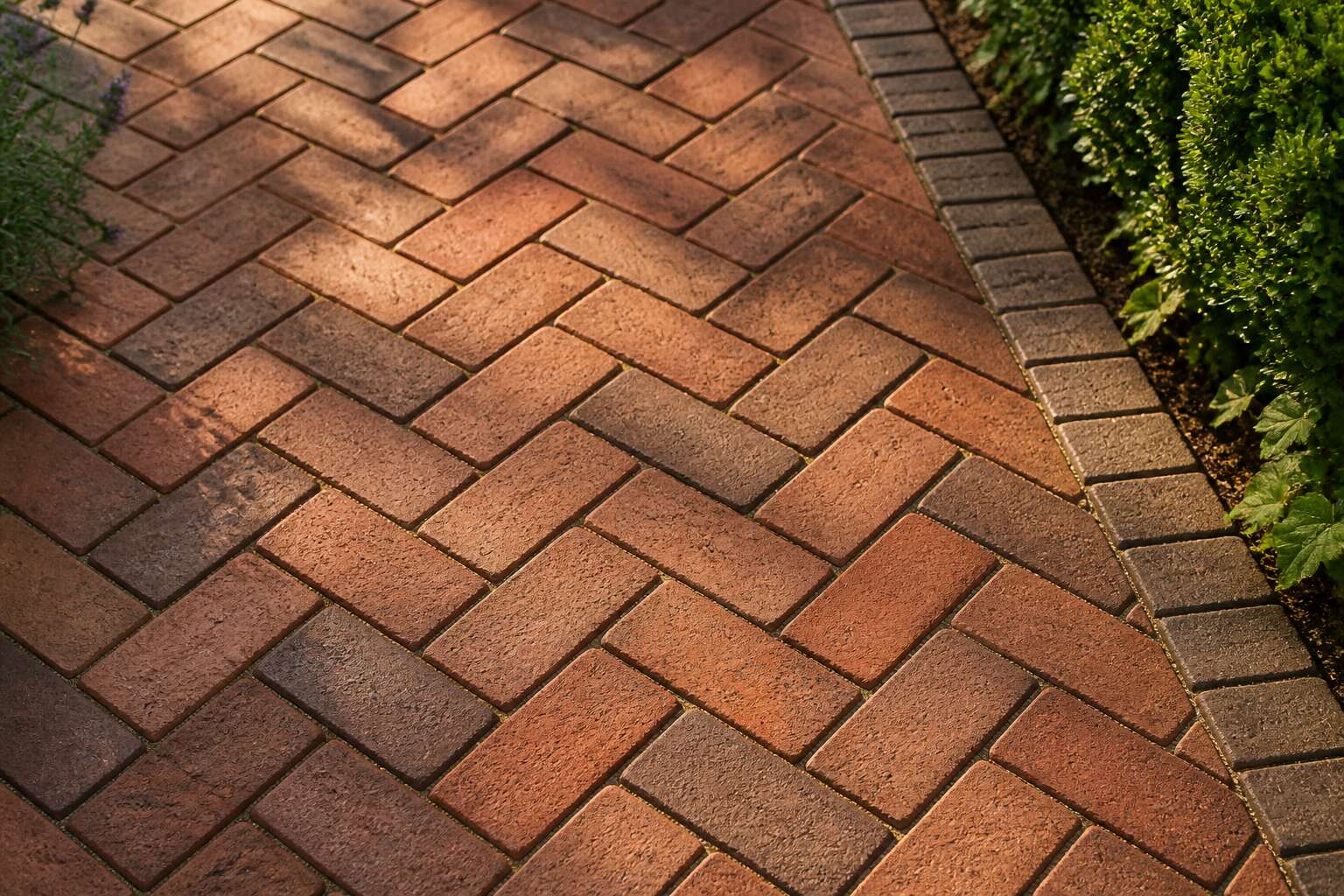
The Origins and History of Herringbone
Ancient Roman Roots
Long before the legions marched, someone in ancient Egypt figured out that angled bricks stay put better than straight ones. But credit for turning this into a formal paving system goes to Roman engineers, who called it opus spicatum, literally “spiked work.” They set rectangular stones at a 45 degree angle so each unit leaned on its neighbour, creating a surface that resisted shifting under heavy cart traffic.
The pattern offered three practical advantages:
- Compression loads spread across multiple bricks instead of single points
- Drainage happened through the gaps without requiring mortar
- Repairs were simple because individual units could be lifted and replaced
These principles survive intact in the traditional herringbone paving pattern used across South African driveways and walkways today.
Evolution Through the Centuries
After the Romans withdrew, the pattern never truly vanished. Byzantine builders kept it alive in church floors, and medieval European masons adopted it for brick courtyards and kitchen hearths where heavy foot traffic wore down softer materials. By the 16th century, Dutch and Flemish bricklayers had refined the technique into a signature craft, laying narrow clay pavers at sharp angles across canal-side lanes and market squares.
The Dutch East India Company carried that expertise to the Cape in the 1600s. Settlers adapted the method using local stone and fired clay, and the traditional herringbone paving pattern became a familiar sight outside Cape Dutch homesteads. Later, Victorian-era engineers standardised brick dimensions, which made the geometric precision we recognise today more achievable for everyday homeowners.
Across South Africa, the traditional herringbone paving pattern still anchors driveways, patios and pedestrian walkways with remarkable staying power.
Herringbone in European Architecture
In the grand salons of 17th century France, the traditional herringbone paving pattern quietly announced a family’s standing. Aristocrats competed for the same Dutch paviers, and a well-laid herringbone courtyard became a social credential. The pattern’s angular discipline carried a certain moral weight, suggesting order and thrift, even among the extravagant.
The fashion spread across the continent. German merchants laid herringbone bricks in their trading yards. Italian architects adapted the motif for garden paths leading to ornamental grottos. Each region added its own nuance:
- French chateaux favoured narrow bricks in warm ochre tones.
- German towns used the pattern to reinforce market square drainage.
- Italian villas paired herringbone with contrasting stone borders.
By the 18th century, this angular arrangement had become a marker of European civic pride, appearing outside town halls and guild houses. It survives in those places to this day!
Cultural Significance
Some of the oldest known herringbone arrangements appear in Africa and Asia. The traditional herringbone paving pattern is not a European invention. Archaeologists have uncovered V-shaped brickwork in ancient Chinese settlements and pre-colonial Southern African sites. Those finds push the pattern’s origins beyond the Roman roads that are usually credited.
In many cultures, the herringbone symbolises connection. The lines interlock, yet never run parallel. That structural relationship carries social meaning few other paving methods achieve:
- Among some Southern African communities, the zigzag motif appears in early floor decoration, where it represented the path between ancestors and the living.
- In parts of Asia, the angle echoes rice stalks, linking the home to the harvest.
- Pacific island cultures marked canoe building sites with similar patterns, aligning the design with travel and trade.
Each group assigned its own meaning, yet the traditional herringbone paving pattern remained recognisable everywhere. I have always found that consistency remarkable!
Design Variations and Pattern Types
Classic 45-Degree Herringbone
The 45 degree angle remains the benchmark in the traditional herringbone paving pattern. I find its diagonal flow creates a sense of movement that straight layouts simply lack. When you step onto a driveway finished this way, the lines carry your gaze forward without any visual dead zones.
For a classic installation, the bricks meet at perfect right angles. This requires precise cutting at the edges. Some contractors prefer a 90 degree orientation for borders, but that changes the rhythm entirely.
Key features of the classic 45 degree layout:
- Uniform brick size keeps the pattern tight
- Borders need half bricks for clean edges
- Fall lines must follow the diagonal
The traditional herringbone paving pattern works best on large surfaces. Small patios can feel busy, yet a generous driveway shows off the geometry beautifully.
Double Herringbone
Some variations refuse to stay quiet. The double herringbone splits the classic chevron into paired courses that mirror each other. It breaks the single line rhythm and demands wider bricks and a steadier hand.
The paired courses create a heavier visual weight. The surface takes on a woven texture. This suits larger estates in Johannesburg or commercial courtyards where a finer traditional herringbone paving pattern would vanish.
The requirements shift accordingly:
- Paired brick courses set at opposing angles
- Wider format bricks reduce edge cutting
- Fall lines remain diagonal for drainage
The traditional herringbone paving pattern changes character in this form. It loses its lightness and gains a brooding permanence. Unlike the 45 degree classic, the double herringbone asks you to pause rather than follow.
Basket Weave vs. Herringbone
No pattern confuses homeowners quite like the basket weave versus the traditional herringbone paving pattern. At a glance both interlock, but the resemblance ends there. Basket weave pairs bricks in neat perpendicular squares. The result is static. Herringbone tilts every unit at an angle to create a continuous zigzag across the surface.
For your driveway or garden path in Cape Town or Durban, consider the following:
- Basket weave suits small patios where you want a calm, symmetrical surface.
- The traditional herringbone paving pattern handles heavy vehicle loads better because the angled bricks lock together.
- Herringbone visually narrows or lengthens spaces depending on the orientation of the joints.
The choice is not about which looks older or more refined. It is about movement. Basket weave is static. Herringbone gives the surface a clear direction. That directional quality matters in large areas.
Scale and Proportion
Scale governs how the traditional herringbone paving pattern performs in a given space. Small bricks, say 50 mm wide, create a dense texture that rewards close inspection. Large formats, by contrast, push the zigzag into a bold, almost graphic silhouette.
Proportion matters just as much as module size. In a long driveway, a fine herringbone can visually stretch the run, while a coarse pattern shortens it. I have seen narrow Cape Town side passages where a compact scale feels claustrophobic, and broad Durban terraces where an oversized unit looks lost.
The angle of the herringbone also changes proportion. A 45 degree set reads as movement, while a steeper 60 degree tilt adds compression. Matching the angle to the site’s dimensions prevents visual discord.
Color Blends and Borders
Color blends set a different kind of tension. A dark grey paver beside a pale sandstone creates a visual pulse. Many South African gardens use this contrast to frame pathways, letting the traditional herringbone paving pattern emerge as though it had been unearthed rather than laid.
Borders act as the discipline that holds the zigzag together. A soldier course or a single row of stretcher bricks prevents the pattern from bleeding into the lawn. Without an edge, the herringbone unravels. With one, it gains quiet authority.
- Blend three tones for depth: charcoal, rust, and pale cream
- Keep borders narrow, under 200 mm, to avoid competing with the pattern
- Match the border material to adjacent masonry for continuity
The most unsettling installations I have seen are those where colour shifts mid-pattern, a wash of lighter units breaking the flow of the traditional herringbone paving pattern. That is not variation but interruption. Keep blends gradual or deliberate.
Practical Benefits and Applications
Durability and Load Distribution
Load tests on clay pavers show that a traditional herringbone paving pattern can reduce surface deformation by up to 45 percent compared with a straight stretcher course. The angled joints resist lateral spread, so the pavement holds its shape under trucks in South African residential estates.
The interlocking effect also limits potholes and edge breakage. When one paver settles unevenly, the adjacent bricks carry the load and stop the failure from spreading. Repair crews can lift a small section and relay it, rather than resurfacing an entire driveway.
Use traditional herringbone where heavy loads are routine:
- Clay pavers on a compacted subbase handle repeated traffic
- Loading docks use it for forklift traffic
- Steep driveways benefit from the traction of angled edges
All of these applications gain from the pattern’s geometry. The traditional herringbone paving pattern costs more due to border cutting, but the extension in service life usually offsets it.
Drainage and Permeability
In a heavy South African downpour, surface runoff turns a driveway into a temporary river. The traditional herringbone paving pattern interrupts that flow. Each angled paver directs water into narrow joints, where percolation takes over. This simple geometry allows rainfall to soak into the prepared base rather than moving quickly toward the street gutter.
For homes and estates, this drainage behaviour offers practical value:
- Prevents erosion along sloped walkways and garden paths
- Reduces puddling on carports and entrance courts
- Supports groundwater recharge in sandy coastal soils
Installers can widen the joint gaps slightly for areas with extreme rainfall, making the pattern as permeable as it is durable.
Suitable Surfaces for Herringbone
Most people only notice a paving pattern when it fails. The traditional herringbone paving pattern, in contrast, performs reliably for decades, which is why it appears on the busiest residential surfaces across South Africa.
This pattern suits areas where feet, tyres, and weather converge. Consider these everyday applications:
- Driveways and parking courts
- Walkways and step treads
- Patios and entertainment zones
- Pool surrounds and splash areas
When one paver cracks, you lift it out and replace it alone. The surrounding units stay undisturbed because the interlocking angles lock each piece against its neighbours. That is not a luxury for homeowners, it is a plain practical benefit.
Residential Driveways
A residential driveway is the one surface where personal taste meets public scrutiny. Neighbours observe every hairline crack, and visitors form opinions before the front door opens. The traditional herringbone paving pattern earns its reputation here, because its locked angles handle repeated tyre pressure without developing the permanent grooves seen in simpler layouts.
For a South African home, this means fewer unsightly repairs and a surface that stays level through summer storms and heavy loads. A single broken paver lifts out cleanly, preserving the rest of the pattern. That practical benefit saves money, but it also spares you the social awkwardness of a driveway that looks abandoned or neglected. A herringbone driveway signals care, consistently, for years.
Commercial and Public Spaces
When municipal engineers specify a traditional herringbone paving pattern for a taxi rank or shopping precinct, they are choosing longevity over fashion. I have watched this traditional herringbone paving pattern absorb the punishment of daily foot traffic and delivery vehicles in Johannesburg’s retail districts, where simpler layouts rut within a season. The locked angles distribute point loads across neighbouring units, which matters when a refuse truck mounts the kerb.
Consider the practical advantages in public spaces:
- Damaged sections lift out individually, avoiding costly full-area replacement
- The pattern conceals the minor unevenness that plagues long-term installations
- Repairs blend with the existing surface, leaving no visible patchwork
For a municipality balancing tight budgets, this translates into lower lifecycle costs. The traditional herringbone paving pattern remains the workhorse of South African public spaces, performing where aesthetics are secondary but failure is not an option.
Installation Techniques and Best Practices
Base Preparation and Sub-Base
Before a single paver is laid, the ground must be stripped back to a depth that honours the weight to come. South African soils often require removing organic topsoil entirely. The exposed subgrade is compacted to a firm, unyielding state. A geotextile membrane can separate the layers and prevent sinking over time.
The sub-base provides structural support. Crushed stone or G5 material is spread and compacted in layers. Depth depends on traffic. Pedestrian areas require 100mm to 150mm, while vehicles demand more. When laying the traditional herringbone paving pattern, the base determines the longevity of the entire installation.
- Compact each layer separately, never all at once.
- Check levels with a straight edge and spirit level.
- Keep the surface slightly crowned to shed water.
Only then does bedding sand go down, screeded to a precise depth. The traditional herringbone paving pattern forgives small errors in alignment, but never a poorly prepared base. The entire structure depends on the sub-base alone.
Laying Patterns and Angles
Few things affect the final look of the traditional herringbone paving pattern more than the chosen angle and the discipline of the laying process. Start each course from a straight reference line, typically a string line pulled from a fixed corner. This ensures that the V shapes remain consistent across the entire surface. For a classic appearance install pavers at 45 degrees to the border, or use 90 degrees for a more uniform, grid like feel. When working with a herringbone layout, dry run a small section first to visualise the flow and adjust for any odd dimensions.
- Use a rubber mallet to seat each paver firmly into the bedding sand.
- Check the spacing with spacers or by eye, keeping the joints tight.
- Cut edge pavers only after the full field has been laid, to match the border precisely.
The angle you choose also dictates how much cutting is required near obstacles. A 45 degree herringbone produces more triangular offcuts, while a 90 degree layout simplifies the edge cuts. Keep the saw blade sharp and measure twice before each cut. Regardless of the angle, the traditional herringbone paving pattern rewards patience.
Cutting and Edging
Cutting edge pavers demands a steady hand and a sharp blade. Measure each paver individually at the border, since dimensions shift across the laying course. Mark the face with a soft pencil, cut with a wet masonry saw. A wet saw reduces dust and keeps the paver cool for a cleaner edge.
In a traditional herringbone paving pattern, the cut pieces along the perimeter reveal the quality of the work. The chosen angle dictates the shape of those cuts:
- A 45 degree herringbone creates triangular offcuts that nestle against a straight border.
- A 90 degree layout produces rectangular cuts, simpler but less forgiving of gaps.
Set each cut paver into fresh bedding sand and tap it home with the rubber mallet. Do not install the edge restraint until every cut is placed. The border locks the field in place, and this finishing sequence completes the traditional herringbone paving pattern.
Jointing and Compaction
Jointing and compaction are often treated as an afterthought, but they determine how long a surface holds its geometry. In a traditional herringbone paving pattern, the interlocking effect depends on joints completely filled with kiln-dried silica sand and locked tight with the right compaction.
I always check a few things before running the plate vibrator:
– The surface must be dry. Moist sand clumps and never reaches the bottom of the joint.
– Use a rubber pad or plastic shroud on the plate to protect the paver edges.
– Work from the edges toward the centre with overlapping passes.
Brush the sand across the surface in several directions, then compact. Add more sand and compact again. The joints settle noticeably, sometimes by more than a third. Once the sand stops moving, the traditional herringbone paving pattern is locked, and the surface is ready to handle traffic.
Maintenance Over Time
One millimetre of bedding error becomes a visible crack three metres away! That is why I stretch a taut string line before laying a single paver. The traditional herringbone paving pattern relies on perfectly aligned edges, so I screed the sand base to a precise tolerance and tap each paver with a rubber mallet until it meets the level datum. An edge restraint, cast in concrete, locks the outer courses and prevents creeping under load.
Maintenance over time asks for vigilance. Kiln-dried sand needs replenishing each spring, because footfall and weather slowly leach it out. Invasive weeds must be removed before their roots prise the pavers apart. A sunken unit calls for immediate lifting, fresh bedding sand, and careful re-laying to match the surrounding height.
- Annual inspection of the edge restraint for cracks or displacement
- Low pressure washing for stains, never a high pressure lance
- Quarterly brushing of fresh sand across high traffic zones
These measures preserve the interlocking geometry, and the traditional herringbone paving pattern stays stable for decades.
Choosing Materials and Cost Considerations
Natural Stone Options
The traditional herringbone paving pattern rewards careful material selection. In South Africa, local stone choices shape both the look and the final bill. Sandstone delivers earthy warmth at a moderate price, while granite commands a premium for its longevity. Slate splits cleanly for precise cuts, reducing waste during installation.
Cost considerations go beyond the stone itself:
- Delivery distance adds significant expense
- Harder stones increase blade wear and labour time
- Sealing requirements vary by stone type
- Offcuts from herringbone cuts can reach 10 percent
I have seen quotes double purely from choosing imported stone over a local equivalent. The pattern amplifies this difference, since every angle requires an additional cut.
Concrete Pavers and Brick
Brick offers a dependable option for the traditional herringbone paving pattern. Clay brick costs less than natural stone and delivers uniform color across the whole project. South African manufacturers produce consistent dimensions, which simplifies the angled cuts herringbone demands.
Concrete pavers are the budget option without sacrificing structure. Modern concrete pavers come in neutral tones that suit Cape Dutch and contemporary architecture alike. Manufacturing produces fewer irregular pieces, so installation moves faster.
Consider these facts when pricing either material:
- Concrete pavers typically undercut brick by a meaningful margin
- Brick holds its color longer than some concrete blends
- Both materials tolerate South African temperature swings well
- Replacement of damaged units is straightforward with both options
The traditional herringbone paving pattern amplifies material cost differences because every joint needs a saw cut. In my experience, cheaper materials still demand skilled labour. The savings over natural stone exist but are not dramatic.
Comparative Costs
Across South African suppliers, the price gap between clay brick and concrete pavers typically ranges from 15% to 40% for a traditional herringbone paving pattern. That gap narrows once you factor in cutting waste and skilled installation. I have seen projects where the material difference of R80 per square metre disappears almost entirely.
Concrete pavers offer immediate savings, but brick may reduce repair expenses over a decade. Consider these comparative factors:
- Concrete pavers cost less per square metre in most South African regions
- Brick requires fewer replacement units after heavy rain or load stress
- Installation quotes vary by up to 30% between provinces
These figures matter more when laying a herringbone pattern, since every angled cut affects both material and labour budgets.
Sustainability and Sourcing
Choosing a traditional herringbone paving pattern starts with provenance. Clay brick fired near Johannesburg shaves hundreds of kilometres off transport emissions compared with imported pavers. Concrete offers durability, yet cement production carries a heavy carbon load.
Sourcing deserves scrutiny. Verify SABS certification before ordering, inspect colour consistency across pallets, and ask kiln operators about fuel sources. Local manufacturers respond faster to warranty claims, and shorter supply routes mean fewer damaged units arrive on site.
Clay brick also holds a second life. Workers can lift, clean, and relay old units after decades of traffic, whereas concrete pavers tend to fracture during removal. That longevity shapes the true cost of a traditional herringbone paving pattern.



0 Comments