Durability and Longevity
Cracking Resistance Under Heavy Loads
Concrete cracks. That is its nature under heavy loads. A single slab bears every kilogram at once, and the result is a series of fractures. Brick pavers, in contrast, work as a collective of individual units. Each unit shifts a fraction, absorbing pressure and passing it along.
The advantages of brick pavers over concrete become obvious in loading docks and parking lots. Where concrete resists and breaks, brick bends ever so slightly and survives. I have seen forklifts roll over the same brick surface for years without a single structural failure!
- Delivery trucks at full capacity
- Turning wheels under heavy braking
- Expanding and contracting soil beneath
That flexibility is the quiet engineering behind true longevity.
Superior Performance in Freeze-Thaw Cycles
Freeze-thaw cycles cause a different kind of damage. Water seeps into microscopic pores, freezes, and expands. Concrete has no room to give, so the surface spalls and flakes away. Brick pavers handle this differently. The joints between each unit provide space for expansion, absorbing the pressure before it reaches the paver body. In South Africa’s high-altitude regions, from Sutherland to the Drakensberg, the advantages of brick pavers over concrete become tangible after just one harsh winter.
- Joints drain water away before it freezes.
- Individual units shift slightly under ice pressure.
- Replacement of damaged pavers takes minutes, not days.
That repairability extends the lifespan of a surface. A concrete slab with frost damage often needs full replacement. A brick surface simply receives new units. Over decades, this difference in maintenance becomes the true measure of durability.
Standing Up to Weather Extremes
The South African sun is relentless. Ultraviolet exposure breaks down concrete surfaces, causing discolouration and a chalky residue that clings to shoes and car tyres. Brick pavers handle this assault with quiet dignity. Their colour runs through the entire unit, not just the surface layer, so fading remains barely perceptible even after decades of Highveld summers.
Hailstorms deliver another test. Large stones strike with enough force to dent vehicles, yet brick pavers absorb these impacts without visible damage. The fired clay body is dense, resilient, and unbothered by the punishment.
Dust and sand, particularly in the Karoo, act like fine sandpaper on smooth concrete. Brick pavers offer a textured surface that wears evenly, maintaining its appearance without the polished sheen that eventually dulls.
- Colour permanence under intense UV exposure
- Impact resistance against severe hailstones
- Uniform wear in sandy, abrasive conditions
These characteristics explain the growing list of advantages of brick pavers over concrete for outdoor surfaces in extreme climates. Homeowners who choose brick are investing in a surface that ages gracefully, not one that surrenders to the elements.
Aesthetic Flexibility and Design Options
Variety of Colors, Shapes, and Textures
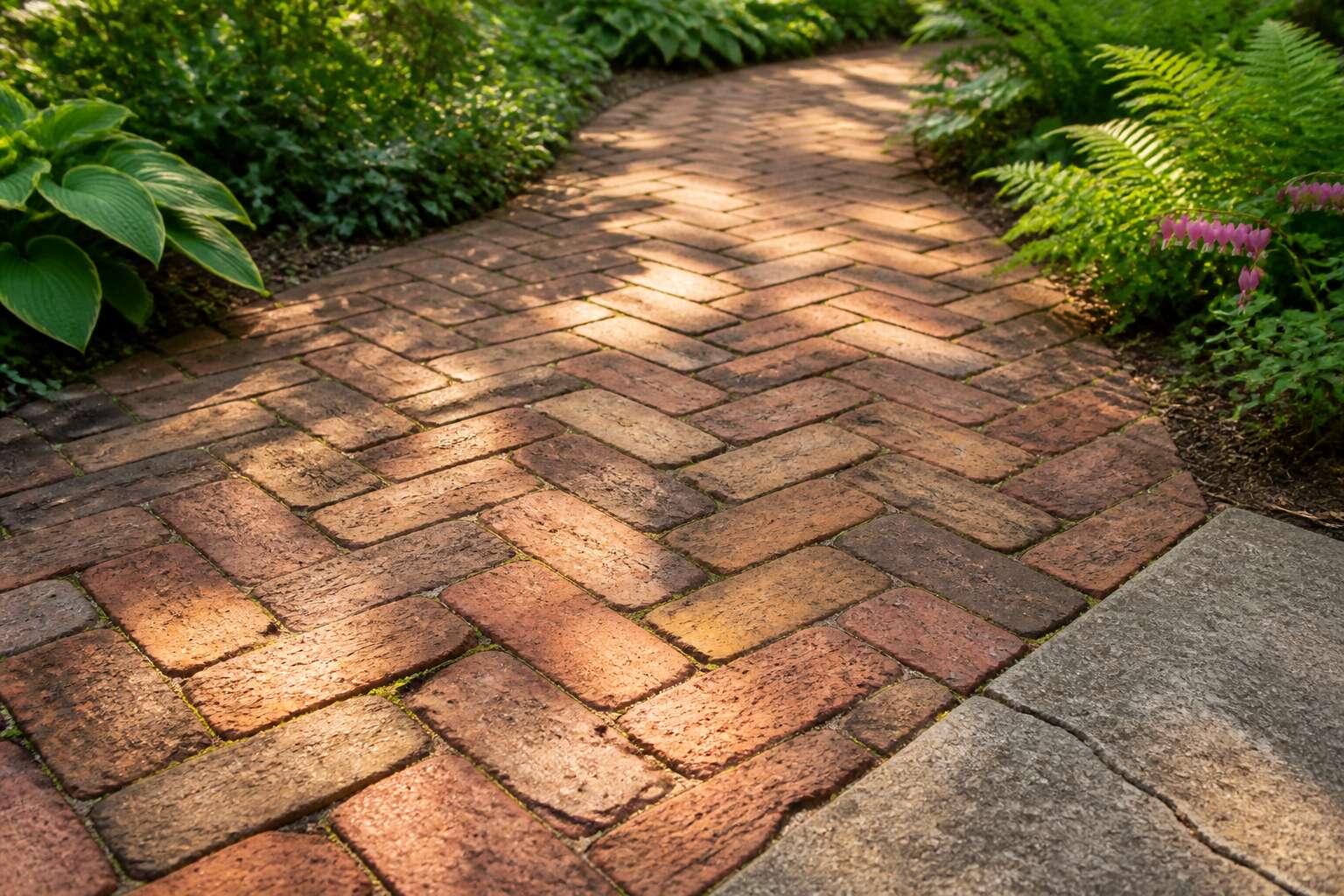
Concrete repeats its grey monotony. Brick pavers offer a range of colours, from burnt sienna to charcoal, and textures of smooth slate or rugged cobble. These choices let you create a ground that reflects your personal style. Shapes and patterns multiply the options. Rectangular pavers in herringbone create movement, while square pavers in basketweave give order.
I have seen a simple patio transformed by mixing two brick colours, a subtle effect concrete cannot match. The variety extends to reclaimed brick for historic warmth, glazed finishes for light reflection, and custom borders that frame the design.
- Reclaimed brick
- Glazed or matte textures
- Custom border profiles
That flexibility is one of the advantages of brick pavers over concrete. Since each unit can be relaid or replaced, your design evolves. These advantages of brick pavers over concrete are not abstract. They show up in the choices you make for your exterior space.
Laying Patterns for a Custom Look
Before a visitor reaches your door, they have already crossed your driveway. The pattern underfoot shapes the feel of the whole property, and laying patterns for a custom look begin with the modular unit itself. A brick paver is small enough to rotate, offset, or interlock in ways a poured slab cannot follow.
I once specified a running bond with a soldier course border for a Johannesburg home. The thin brick edging framed the field, giving the expanse a tailored finish.
- Running bond for a continuous, linear flow
- Soldier course for sharp, clean edges
- Stack bond for a restrained, grid-like finish
This control is where the advantages of brick pavers over concrete become visible. Your design does not end with a pour; it continues with each piece you place!
Mixing Brick with Other Materials
Concrete slabs impose one material on the landscape. Brick pavers hold a quieter conversation with what surrounds them. In a Johannesburg garden, I once specified brick pavers against aged slate and river pebbles. The paver field absorbed the morning light, the stone caught the shadows. That tension is where the advantages of brick pavers over concrete become tactile.
Concrete cannot step aside for a tree root or a stormwater channel. Brick can open a path for something else. Mixing materials creates edges that feel considered rather than extruded. I reach for textures that contrast with the brick’s regularity. Pair them:
- Timber sleepers for a softer boundary
- Crushed granite to blur the transition
- Rough-cut stone to echo a natural outcrop
Each pairing changes the temperature of the space. A poured slab offers no such dialogue. The advantages of brick pavers over concrete are clearest side by side. The hardscape feels assembled, not forced. That is the difference.
Timeless Appeal That Boosts Curb Appeal
An estate agent in Pretoria once told me that a brick paved driveway closes a sale faster than any interior renovation. Buyers read that patina as proof of care. Concrete offers no such signal.
Design options multiply when you move beyond standard slabs! Brick pavers tolerate changes in grade and direction. They can step down a slope, wrap a planter, or open a seam for future services. Concrete pours resist such adjustments.
- A wide band of pavers frames the front door
- A gently angled path meets the street
- An open paver field gives the lawn a clear boundary
The advantages of brick pavers over concrete become visible in the fourth or fifth year. Concrete develops grey patches and chalky edges. Brick deepens its colour and settles into the landscape. That trajectory boosts curb appeal long after installation.
Maintenance and Repair Advantages
Individual Paver Replacement Made Easy
Nobody takes pleasure in repairing a driveway. Yet the advantages of brick pavers over concrete become obvious when a crack appears. Concrete forces a demolition project. Brick pavers offer a polite solution.
Each paver stands alone. Damage affects one brick, not the entire slab. You lift the offender, swap in a fresh unit, and sweep sand into the gaps. No jackhammers, no curing time.
- Spare pavers from the original batch
- Simple tools: a screwdriver and a mallet
- Repairs done in under an hour
The contrast with concrete is stark. A crack in concrete demands cutting or full replacement. That costs money and patience. Brick pavers let you manage the repair on your own schedule, even when your bakkie leaks oil over the exact spot.
Simpler Cleaning and Staining Solutions
Oil from a bakkie’s sump leaves a mark on concrete that resists degreasers. The same spill reveals one of the advantages of brick pavers over concrete. Pull that stained unit, drop in a spare, and the surface looks untouched. No trace of the spill remains!
Cleaning pavers also rewards ordinary effort. A pressure washer clears grime from the joints without eroding the pavers themselves. Concrete holds embedded dirt in its porous surface. Pavers release it, saving hours of scrubbing.
A common routine stays simple:
- Mild detergent for organic stains
- A dedicated paver sealer applied yearly
- Efflorescence brushed away with water
Sealing offers another benefit. A quality sealer protects the colour and reduces oil absorption. Concrete needs acid etching to look fresh again.
Managing Weeds and Moss Without Resurfacing
Managing weeds and moss without resurfacing reveals one of the decisive advantages of brick pavers over concrete. In South Africa’s high rainfall regions, moss attacks joints relentlessly, yet a simple treatment clears it. Pull a stubborn weed, scrub the joint with a stiff brush, and the paver stays intact.
Concrete fights back poorly. It requires acid washing, pressure blasting, or even a new topping layer to remove organic growth. That resurfacing disrupts driveways for days. Pavers skip that mess entirely. Moss slips off the dense brick surface, while weeds never anchor deep enough to cause structural harm.
For long term control, I keep this routine simple:
- Sweep silica sand into joints to block seed penetration
- Apply a moss killer diluted with water every autumn
- Blow debris away from edges weekly
The maintenance cost stays low because the base never needs replacing. That is the quiet win of brick pavers over concrete.
Long-Term Resistance to Weather Stains
Weather stains show how a surface holds up over time. Concrete absorbs oil, rust, and leaf tannins deep into its pores, leaving permanent shadows. Brick pavers, fired at high temperatures, resist this absorption naturally. Spills stay on the surface where rain or a rinse removes them. This is one of the advantages of brick pavers over concrete that becomes clearer with every passing season.
Long term exposure to harsh sunlight, coastal salt, or acid rain does not alter the paver’s original colour. Concrete often develops a yellowed or mottled appearance after a few years. Brick keeps its tone. For maintenance, the routine stays simple:
- Hose off surface dust and grime monthly.
- Tackle oil stains with a degreaser and a stiff broom.
- Rinse with clean water, no pressure washing needed.
This low effort protection means the driveway still looks deliberate and cared for, even after decades of weather.
Installation and Structural Benefits
Base Preparation and Interlocking Stability
The installation of brick pavers demands proper base preparation, but that upfront effort pays off in stability. A compacted sub-base of crushed stone, typically 100 to 150 millimetres deep for driveways, distributes vehicle loads evenly. This matters in South Africa, where soil conditions vary dramatically from coastal regions to the Highveld. Without a solid foundation, any hard surface will shift over time.
Brick pavers deliver structural benefits through interlocking stability. Sand-filled joints allow individual units to shift slightly while maintaining overall cohesion. Poured concrete forms one rigid slab, so when the ground moves, the slab cracks. Pavers flex as a system.
These advantages of brick pavers over concrete appear during installation:
– Workers lay each unit individually, catching base issues early
– Open joints permit drainage, reducing hydrostatic pressure
– A damaged section is lifted and replaced without disturbing neighbours
The advantages of brick pavers over concrete extend beyond materials, rooted in how the system is built.
Flexibility to Adapt to Ground Movement
South African clay soils swell when wet and shrink during dry spells. A monolithic concrete slab cannot accommodate this movement, so it tears apart. Brick pavers behave like a flexible membrane. Each unit shifts marginally, absorbing the earth’s breathing without sacrificing the whole.
I have watched this system save homeowners from disaster on the Highveld, where drought cycles punish rigid surfaces. The advantages of brick pavers over concrete appear in these moments. The ground moves, the pavers move with it, and the driveway remains intact. A poured slab would have fractured within the first season.
Permeable Options for Better Drainage
Watching a crew lay brick pavers is a masterclass in patience. The base preparation alone, the careful grading and compaction, determines whether the surface will hold firm for decades. Concrete demands formwork and a single continuous pour. Brick pavers arrive as individual units, each one set by hand into a sand bed, then locked together by the interlocking edges. This installation process creates a structural system that distributes weight far more evenly than a slab ever could, and here the advantages of brick pavers over concrete show themselves plainly.
Where drainage matters, especially across the wet coastal regions of KwaZulu-Natal, those same advantages of brick pavers over concrete become obvious. Concrete sends water running off to the edges, pooling where you least want it. Pavers with permeable joints allow rainwater to filter straight down into the subsoil below.
Reduced Risk of Surface Ponding
The installation sequence for brick pavers builds in drainage from the ground up. The compacted base layers establish precise gradients before a single paver is laid, so the finished surface follows a true fall. Concrete, by contrast, depends entirely on the pour. If the formwork shifts or the slab cures unevenly, low spots become permanent ponds.
Surface water behaves differently on a paver system. The joints between units interrupt the flow, breaking up sheets of water before they can gather volume. Even as individual pavers shift slightly under traffic, the surrounding field keeps its level, so puddles never get a foothold. Across a driveway or patio, these advantages of brick pavers over concrete translate into a surface that stays dry underfoot after downpours.
Cost-Effectiveness and Property Value
Lower Lifetime Cost Compared to Concrete
Consider the ledger, not just the invoice. Concrete might appear cheaper on day one, but the advantages of brick pavers over concrete show up in the maintenance column. A concrete slab cracks, stains, and requires demolition when it fails. Brick pavers, once laid, can be lifted and reset. That difference protects your investment!
Here is what happens over twenty years:
– Concrete surfaces often need sealcoating or replacement.
– Brick pavers require only occasional sand topping and washing.
These factors directly influence property value. A home with a sagging driveway loses appeal. A brick paver terrace signals longevity. In South African climates, that durability translates into a lower lifetime cost compared to concrete. You spend less on repairs, and the resale value holds firm. These advantages of brick pavers over concrete rarely appear in the initial quote, but they define the real cost.
Higher Resale Value for Homes and Patios
A home’s outdoor surfaces speak before the front door opens. Property appraisers in South Africa increasingly recognise brick pavers as a value driver. When buyers compare two similar homes, the one with a paver patio often commands a higher offer. That is the practical side of cost-effectiveness: you recover a portion of the investment at resale.
Brick pavers offer a sense of permanence that concrete slabs lack. A cracked concrete driveway triggers negotiation. A well-laid brick surface invites confidence. This is where the advantages of brick pavers over concrete become visible in the property market. Homes with paver patios sell faster, and estate agents use the material as a selling point.
Consider the long view. A paver terrace built correctly will outlast the mortgage. That durability translates directly into higher resale value for homes and patios.
Minimal Repair Expenses Over Time
Few homeowners budget for the slow creep of repair costs. Concrete slabs disguise their deterioration until the cracks spread, then the expense arrives with force. Brick pavers behave differently. Their repairs are modest in scale and cost. This is where the advantages of brick pavers over concrete become practical rather than aesthetic.
The economic argument rests on predictability. A concrete driveway may need resurfacing within a decade, a cost that runs into five figures in South African terms. Brick pavers stay intact for decades with little more than a rinse and a top-up of joint sand.
Consider the repair ledger over twenty years:
- Concrete: crack filling, surface patching, eventual resurfacing.
- Brick pavers: occasional sand replenishment and a spot fix or two.
That difference in upkeep keeps property values steady. Minimal repair expenses over time make the home cheaper to maintain, and cost-effectiveness remains visible in every future budget.
Potential Insurance and Warranty Advantages
Property value is tied to what you don’t spend as much as what you add. A concrete slab that cracks can trigger insurance claims, and many policies limit coverage for structural settling. That leaves you holding the bill. With brick pavers, the advantages of brick pavers over concrete extend into warranty protection. Most reputable manufacturers warrant their pavers against chipping and colour fade for decades, and contractors back that with installation guarantees.
Cost-effectiveness appears in the ledger:
- No expensive sealant schedules
- No joint repair machines
- No premium for special underlayment
That predictable spending builds buyer confidence. In our experience, South African property appraisers notice surfaces that look maintained, not patched. Insurers also see a product less prone to sudden failure, which can help keep premiums steady.
Safety and Comfort Features
Slip Resistance for Walkways and Pool Decks
Bare feet on a slick pool deck create a hazard that no amount of caution can fully counter. Brick pavers, with their inherently gritty surface, offer a dependable grip that concrete slabs often lack. The fired clay texture provides microscopic irregularity, which means water disperses across the paver rather than forming a dangerous film. For walkways and pool decks, this translates to a quieter confidence underfoot.
Consider the specific moments: children darting from the shallow end, or adults carrying drinks while chatting. Concrete, once wet, becomes a slide; brick maintains its purchase. Contractors in Johannesburg and Durban routinely specify brick pavers for these zones, citing slip resistance ratings that exceed typical concrete finishes.
- Surface texture from the paver’s manufacturing process
- Sand joints that absorb water and add traction
- Chamfered edges that channel runoff efficiently
These features contribute to the broader advantages of brick pavers over concrete, especially where safety meets daily leisure. The comfort extends beyond grip, as brick stays cooler than concrete under African sun, making barefoot movement more pleasant.
Heat Absorption and Cooler Surface Temperatures
On a 35 degree African summer day, a concrete slab absorbs solar heat and releases it long after sunset. Brick pavers handle the same sunlight differently. Their fired clay structure reflects more light, and the sand joints let trapped heat escape instead of baking into the surface.
The difference is immediate. I have stood on a concrete driveway in Pretoria at noon and felt the burn through shoe soles. The adjacent brick path stayed noticeably cooler. Darker brick shades do absorb some heat, but the material’s porosity releases it quickly. Concrete’s dense slab holds warmth all night.
This is the quiet reason many homeowners switch. The advantages of brick pavers over concrete show up in everyday moments, like stepping outside without shoes or letting kids play on the patio during the hottest part of the day.
Comfortable and Natural Walking Surface
Standing on brick pavers for the first time feels unexpectedly different. The surface yields in tiny, quiet ways that concrete never does. Sand joints between each unit absorb pressure and allow a slight shift underfoot, which reduces strain on knees and ankles. After a long afternoon in the garden, I notice the difference in my lower back.
- The fired clay texture provides natural grip without feeling abrasive.
- Individual pavers move imperceptibly, softening each step.
- Small surface variations engage the foot’s natural mechanics instead of forcing a rigid stance.
Concrete demands your body adapt to its flat, unyielding slab. Brick pavers adapt to you. The advantages of brick pavers over concrete become obvious when your feet feel fresh at the end of the day.

0 Comments