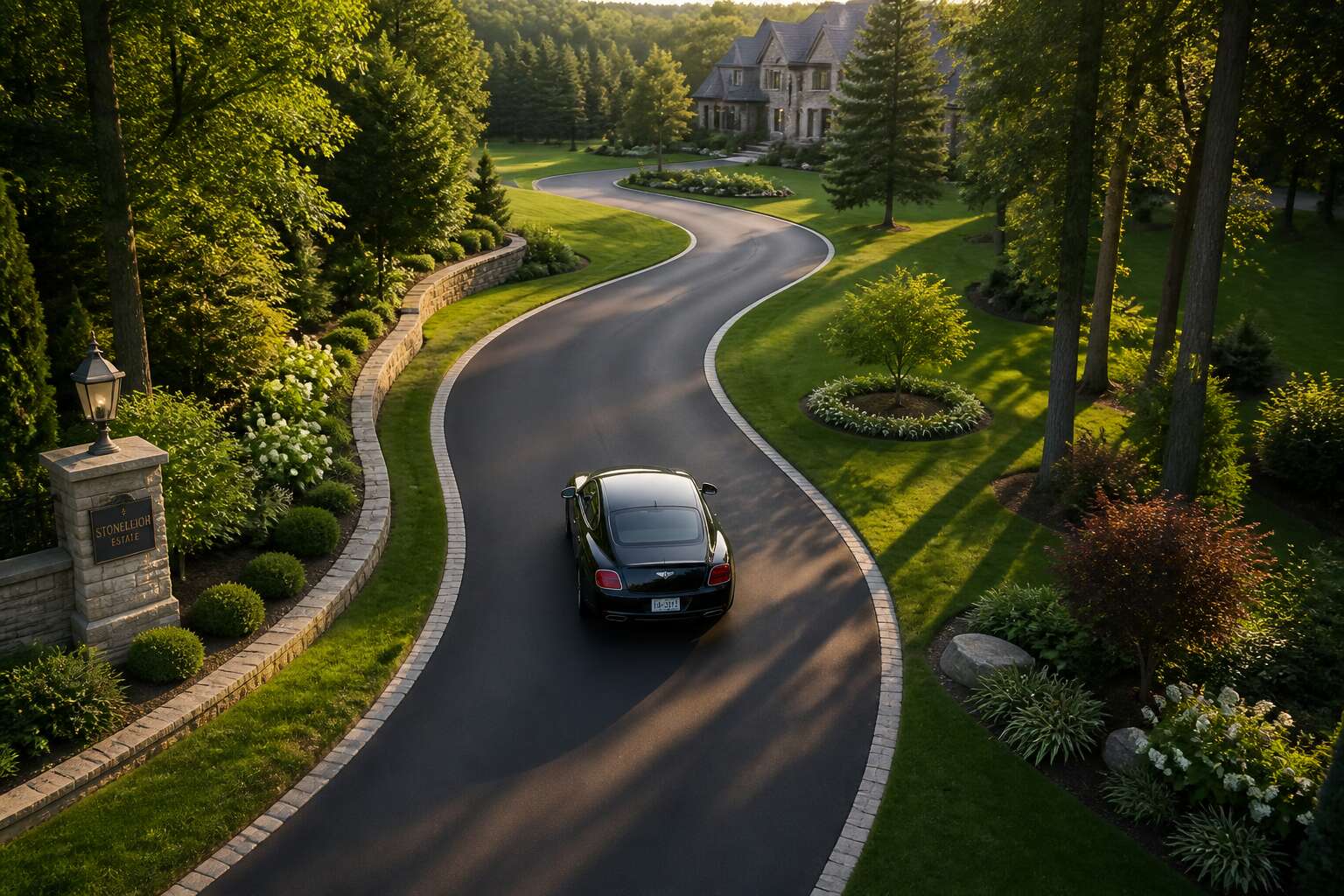
Key Benefits of Professional Driveway and Private Road Paving
Enhancing Property Value and Curb Appeal
According to property experts, a well-paved driveway can add as much as 5% to a home’s resale value. On estates, where every entrance is scrutinized, professional estate road paving transforms cracked gravel into clean, seamless surfaces that immediately raise the visual bar!
Quality estate road paving materials resist erosion and potholes, which means fewer repairs and a safer approach for vehicles and pedestrians. This durability directly supports curb appeal, as neat edges and smooth textures signal careful upkeep.
- Enhanced property value
- Lower long-term maintenance
- Improved safety and drainage
We have seen how a smooth driveway changes perceptions of an entire property. When you invest in professional work, you fix more than a path. You elevate the entire entry experience, a practical upgrade that buyers notice before they even step inside.
Improving Safety and Accessibility
The quiet hum of tires on a smooth surface is a sound of order, a promise of arrival without incident. When the fabric of a private road begins to fray, with its attendant ruts and loose stones, the very act of returning home becomes a small negotiation with hazard. Professional estate road paving reweaves that fabric into a taut, even plane, ensuring that every journey, from the hurried school run to the solemn procession of a funeral, is conducted with grace and, more importantly, with safety.
This is not merely about aesthetics; it is about the physics of contact. A poorly maintained surface offers unpredictable traction, a treacherous gamble in the South African summer downpour. A professionally paved estate road provides a consistent grip, allowing vehicles to brake and accelerate with confidence. For the pedestrian, the elderly resident, or the child chasing a ball, the difference between a stable, clean edge and a crumbling, uneven verge is the difference between a stroll and a stumble.
The benefits of this meticulous approach extend to the very infrastructure of the estate.
- Elimination of trip hazards, such as raised edges and deep potholes.
- Clear, defined pathways that guide drivers and reduce the risk of collisions.
- Improved water runoff, preventing the pooling that turns a driveway into a skating rink.
Accessibility is the silent partner in this design. A surface that is flush with the curb line invites wheelchairs, prams, and mobility scooters without a jarring bump. It speaks to a community that values the movement of all its members, not just those in motor vehicles. In this way, the paving of an estate road becomes a statement of intent, a physical declaration that every resident, and every visitor, is expected and welcomed. The surface itself is the quiet custodian of that promise, holding firm against the elements so that the path home is always open.
Reducing Long-Term Maintenance Needs
The true cost of an estate road is not measured at the moment of installation, but in the decades that follow. A cheap surface is a slow leak on the finances of a community. Every pothole is a deferred payment, a promise of future expense that grows with interest. Professional estate road paving is an investment in the future, a decision that the ground beneath our wheels should not demand constant attention.
The choice of materials and the precision of the base layer determine the lifespan of the road. When a contractor cuts corners, the surface succumbs to the relentless pressure of water ingress and heavy vehicles. The result is a cycle of patchwork repairs that never truly solve the problem. A properly paved road, by contrast, is designed to withstand the load. It resists the elements, so the estate does not have to.
This foresight translates directly into reduced operational costs. The estate’s budget is freed from the endless cycle of emergency callouts and temporary fixes.
– Fewer structural failures mean lower repair bills.
– A stable base prevents the formation of cracks that allow water to undermine the foundation.
– The longevity of the materials reduces the frequency of complete resurfacing projects.
– Preventative maintenance becomes a simple inspection, rather than a full-scale reconstruction.
The peace of mind that comes with this reliability is a form of wealth in itself. The road does not demand to be the centre of attention. It simply exists, a silent and steadfast servant. This is the mark of true craftsmanship: an infrastructure that supports the community so the community can focus on living, not on the cost of repair.
Environmental Considerations and Drainage
Most estate road paving failures begin with water, not traffic. In South Africa, intense summer storms can overwhelm a poorly drained surface in a single season. Water seeps into the base layer, and the structure loses its load-bearing capacity from within.
Proper drainage design routes stormwater away before it can do damage. Crossfalls, kerb inlets, and French drains work as a system to move water off the pavement efficiently. When these elements are planned during construction, the surface remains stable through heavy downpours.
- Permeable paving lets rainwater return to the groundwater table, easing pressure on municipal stormwater systems.
- Vegetated swales along the road edge filter pollutants and prevent erosion of the surrounding soil.
- Directing runoff away from the road base protects the structural integrity of the entire pavement.
Environmental considerations now influence estate road paving material selection and layout. Sustainable drainage features reduce the ecological footprint while extending the lifespan of the pavement itself.
Choosing the Right Surface Material for Your Private Road
Asphalt vs. Concrete vs. Gravel
Asphalt absorbs the heat of a Highveld afternoon. Concrete holds its form against the shifting clay beneath. Gravel offers a quieter surrender. The choice for estate road paving mirrors the character of your property.
Each surface demands a different pact with nature. Asphalt flexes, concrete cracks with intention, gravel moves with every storm.
- Asphalt suits long curves and gentle slopes.
- Concrete endures heavy vehicles and sharp turns.
- Gravel suits remote drives where drainage is erratic.
I have seen paving decisions made on aesthetics, only to regret the erosion within three winters. The cost of that mistake appears with the first heavy rain! The soil, the rainfall, and the rhythm of daily traffic will have their say.
Decorative Options for High-End Estates
A private road is a statement of arrival, and the surface under your wheels should speak with the same authority as the gatehouse. The tactile quality of the drive, the sound of gravel beneath tyres, the sheen of a well-laid finish, these details form the first impression for every guest and the daily comfort for residents. The choice of material for your estate road paving should therefore be a deliberate act of curation, not an afterthought.
The true art of high-end paving lies in the unexpected. Consider moving beyond the standard palette of greys and blacks. Exposed aggregate offers a terrazzo-like texture that catches the Highveld light with a subtle, mineral sparkle. For a more formal approach, clay pavers in a herringbone pattern evoke a sense of old-world permanence, while large-format concrete slabs with a honed finish provide a sleek, gallery-like minimalism. Each option presents a distinct personality, from rustic charm to unapologetic modernity.
When contemplating these premium surfaces, the practicalities of installation and layering become paramount.
– A permeable interlocking paver system is essential for estates with high water tables, as it allows for natural drainage.
– Consider a stabilised sand base for paving stones to prevent movement on clay-heavy soils.
– For a seamless transition, specify a matching border material to edge the asphalt or concrete, creating a customised frame for the entire entrance.
Ultimately, the selection is a negotiation between your aesthetic ambition and the terrain’s quiet demands. A driveway that mirrors the architecture of the main house, using complementary colours and textures, creates a sense of holistic design. The most successful projects are those where the paving feels inevitable, as if it had grown from the earth itself. A bespoke approach to your estate road paving ensures that this essential element becomes a defining feature of your property’s legacy.
Climate Suitability and Durability
The Karoo’s scorching summer and the Cape’s battering winter rains demand opposing responses from the same estate road paving. I have watched clay pavers fracture under thermoclinal stress on a Northern Cape drive, while a neighbouring concrete surface wept from alkali-silica reaction after persistent moisture. That is a lesson I learned the hard way!
Durability is not a fixed property. The surface must survive the site’s microclimate.
- Temperature extremes dictate the need for flexible surfaces like interlocking blocks
- Heavy rainfall requires permeable substrates to resist hydrostatic uplift
- Frost pockets, even rare in South Africa, call for low-porosity stone
Selecting a material without this audit is an act of folly. The ground will always have the final word.
Preparing for a Residential Road Paving Project
Assessing Site Conditions and Soil Stability
Most estate road paving failures begin with the ground, not the asphalt. A simple percolation test and soil analysis can reveal a hidden layer of instability. In South African estates, where granite based soils and expansive clays are common, skipping this step is a gamble.
Assessing site conditions involves examining drainage patterns, root zones, and the slope of the land. For a proper soil stability check, I always recommend:
- Conducting a visual survey after heavy rain
- Testing compaction resistance at multiple depths
- Reviewing the water table level
These steps shape the foundation design. Without a stable subgrade, even premium paving materials will shift, crack, or sink within a season.
Obtaining Necessary Permits and HOA Approvals
Municipal approval can take six weeks or eight months, depending on the backlog. Estate road paving rarely stalls because of the asphalt. It stalls because the paperwork was never finished.
I always request the estate’s constitution before anything else. That document names the body with signing power over shared roads. I then verify servitudes with a land surveyor. A missing signature halts the entire project.
- HOA consent letter
- Approved building plans
- Stormwater management statement
Each of these items carries its own fee and waiting period. Budget for both.
Budgeting and Timeline Planning
Budgeting for estate road paving in South Africa requires a contingency buffer of at least 15%. Material prices shift with fuel costs and exchange rates, so a quote from May rarely holds in August. Cover unexpected rock, drainage fixes, or supplier delays before they hit your cash flow.
Timeline planning means booking asphalt plant slots before you finalise the budget. Permits eat months, as discussed. Once approved, production runs two to four weeks ahead, so reserve your paving date early. A simple sequence helps:
- Secure three quotes
- Confirm plant availability
- Lock a provisional start date
Weather remains the biggest variable. One thunderstorm can delay laying for a week. I have seen estates pay premium rates for emergency recompaction after tight schedules collapsed. Leave slack in your calendar and your cost sheet. Ordinary estate road paving takes eight to twelve weeks, but assume something shifts.
Choosing the Right Contractor
Preparing for estate road paving demands more than a signed contract. Walk the route yourself, photograph existing drainage, and mark utility lines. This baseline protects you when the contractor reports issues later. It also builds trust, since you can judge their claims against your own observations.
Choosing the right contractor for estate road paving starts with recent local work, not glossy brochures. Ask about wet weather rescheduling and subgrade surprises. Call previous clients about communication during disruptions. One honest reference from a past estate manager outweighs a dozen quotes.
When you shortlist candidates:
- Verify their CIDB grading and public liability insurance.
- Request a site-specific method statement, not a generic one.
- Confirm they use local subcontractors familiar with municipal specifications.
I have walked enough failed paving jobs to know that the contractor you choose shapes how residents experience disruption. Patience and transparency matter as much as machinery.
Understanding the Scope of Work
Most estate road paving projects falter on a blurred line of responsibility. Understanding the scope of work starts with mapping the exact footprint of the new surface. This goes beyond the visual road width. It demands a walk over the full alignment to identify where the pavement sits relative to title deeds and servitudes. You need to see the existing manholes, fire hydrants, and the camber of the current surface.
- Boundaries of the road reserve versus private erf lines
- Locations of underground water and electrical services
- Depth of the subgrade needed for the intended vehicle loads
Scope also covers sequencing. A residential estate has active entrances. The contractor needs to maintain a drivable surface for daily commuters. A clear plan dictates the phasing of the works, ensuring the new estate road paving ties into existing retaining walls and gatehouses without leaving an unfinished lip. This level of detail prevents the project from becoming a moving target.
The Paving Process from Start to Finish
Site Clearance and Grading
The first scrape of a blade against raw earth is where estate road paving truly begins. Site clearance goes beyond simple removal of brush; it demands careful mapping of buried utilities and preserving the natural contours of a South African plot. This stage prevents costly surprises later when graders encounter rock or hidden services.
What does proper clearance entail?
- Stripping all topsoil to expose mineral subgrade
- Relocating or stabilizing existing trees and roots
- Disposing of debris to designated waste sites
Once the surface is bare, grading takes over. Laser-guided machinery shapes the ground to a precise fall, directing stormwater away from the road base. Without this exacting step, water pools beneath the pavement and shortens its life. Estate road paving depends on this unglamorous groundwork, where patience and millimeter-level accuracy decide the future integrity of every layer above.
Sub-base Installation and Compaction
The poet may romanticise the earth, but the engineer knows it must be crushed, wetted, and beaten into uniformity. After grading, the sub-base installation begins. This is the silent stratum that carries every vehicle to come. A failure here never forgives; it surfaces later as cracks and depressions.
For estate road paving, the sub-base is a mix of crushed stone or gravel, spread in lifts of no more than 150mm. Estate road paving demands a sub-base that does not move. Each lift is watered and compacted to the required density. Too dry, and the particles refuse to lock; too wet, and the soil pumps beneath the roller. The correct sub-base depends on:
- The parent geology of the site
- The expected traffic load
- The drainage characteristics
Compaction is measured, not guessed. A nuclear density gauge confirms the layer is ready. The process repeats until the ground is a single, monolithic layer. No poetry here, only the slow pulse of the compactor and the certainty that what is buried will hold.
Paving and Finishing Techniques
Once the sub-base is sealed, the paving process begins. For estate road paving, this stage separates a contractor who plans from one who improvises. Asphalt arrives at around 150 degrees Celsius and must be laid before it cools. Concrete needs formwork, a strike-off bar, and a bull float finish. In either case, the crew works in one continuous movement.
Finishing techniques determine how the surface performs:
- Screed the material to the correct profile.
- Compact with the right roller weight and speed.
- Cut contraction joints at controlled intervals.
- Cure the surface to prevent moisture loss.
The straightedge test happens within minutes. In South African conditions, the sun can pull moisture from concrete quickly, so curing compound goes on early. A smooth, dense finish on estate road paving prevents pooling and extends the road’s life. The paving process ends when the surface accepts water and traffic without damage.
Curing and Initial Care
A freshly laid surface looks finished, but the curing process determines whether estate road paving lasts for decades or fails within years. In South Africa’s intense sun, moisture evaporates rapidly, so concrete must stay damp for at least seven days. Asphalt needs time to cool and settle evenly. The crew applies curing compound immediately after finishing.
In our experience, the first week decides the road’s long term behaviour. Initial care protects the freshly paved estate road from traffic and water runoff. Barricades stay in place until the material reaches full strength. Workers check for cracks and monitor moisture levels. Contraction joints are cut within 24 hours to control shrinkage. Proper curing turns a raw pavement into a resilient surface that serves residents quietly for generations, which is the true measure of successful estate road paving.
Maintaining and Extending the Life of Your Paved Private Road
Routine Inspections and Cleaning
The difference between a minor crack and a full reconstruction often comes down to one season of neglect. For estate road paving, routine inspections are the first defence against costly failure. Walk the surface monthly and look for hairline fractures, loose edges, or standing water. Cleaning matters just as much. Leaves and soil trap moisture against the asphalt, accelerating breakdown. A stiff broom or a gentle pressure wash clears the way for a longer lifespan. When inspecting, pay attention to:
- Expansion joints where movement occurs
- Drainage channels that may clog
- Patches from previous repairs
Address small issues within weeks. Early intervention preserves the base layer, which carries the load of your estate road paving.
Sealcoating and Crack Repair
Every road has a failure point. That point often appears as a thin, jagged crack after a hard winter. Sealing that crack prevents structural decay. It stops water from reaching the base layers, where the true damage occurs.
Sealcoating your paved private road adds a protective film over the entire surface. This layer defends against the harsh South African sun, which oxidises the asphalt and makes it brittle. A well-timed sealcoating schedule, usually every two to three years, can add a decade of life.
- Alligator cracking near the edges
- Standing puddles after rain
- Faded colour or rough texture
Address these signs before the road fails. Crack repair and sealcoating work together to protect the substrate beneath your tyres. Without this ritual, your estate road paving will deteriorate.
Managing Drainage and Vegetation
Water and roots undermine more estate road paving than heavy traffic ever will. A blocked drain sends runoff sideways, underneath the pavement, where it erodes the base. Overhanging branches drop leaves that trap moisture, while roots probe beneath the surface, lifting the asphalt from below.
Watch for these early signs:
- Water pooling along the edges long after the rain stops
- Veins of dark, damp soil washing onto the pavement
- Cracks that align suspiciously with nearby tree trunks
Managing drainage and vegetation is the quiet labour that preserves the paved surface. Clear the gutters before each rainy season and cut back aggressive growth. The road will stay smooth and stable for years longer.
When to Consider Resurfacing
Every estate road paving project carries a hidden promise. The surface will remain smooth and safe for decades. Fulfilling that promise demands more than admiring the initial finish. It requires a vigilant eye for subtle changes that signal wear.
Regular maintenance, like sweeping debris and addressing minor cracks promptly, prevents small imperfections from becoming structural failures. The principle is simple. Never let water stand where the sun should dry it. South Africa’s varied climate, from Highveld storms to coastal humidity, tests every layer.
Resurfacing becomes necessary when the road’s integrity is compromised. Look for these signs!
- Alligator cracking over a third of the surface
- Ravelling, where aggregate loosens and pebbles scatter
- Rutting deeper than 20 millimetres in wheel paths
Ignoring these signs accelerates base deterioration. A professional assessment every few years offers clarity. A well-timed overlay restores driveability and protects your estate road paving investment for years.

0 Comments