Understanding Driveway Blind Zones
What Creates a Blind Spot in a Driveway
In South Africa, roughly one in five driveway incidents occurs while a vehicle reverses toward the street. The danger sits in the blind zone, the area your mirrors cannot reveal. For a family home with high boundary walls and a sloping entrance, this zone expands far beyond what most drivers expect.
Understanding what creates a blind spot in a driveway starts with geometry. The key factors are:
- Boundary walls and pillars that block the sightline between the driver and the street.
- An inclined driveway that tilts the vehicle’s nose upward, obscuring low objects directly behind it.
- Gate motors, post boxes, or dense planting near the entrance that interrupt a clear view.
Each element extends the hidden area where a child, a pet, or a pedestrian can stand undetected. Blind spot driveway paving works by reshaping these conditions, giving the driver a longer and clearer line of sight before the gate opens.
Common Accident Scenarios at Residential Entrances
Every day, a South African driver reverses into something they cannot see. The wing mirrors work fine, but the space behind the bumper stays a mystery. This is the residential driveway paradox: the shorter the driveway, the longer the list of hidden hazards. A skateboard, a garden hose, a child bending to tie a shoe. They all gather in the blind zone.
Common accidents repeat because the geometry of the entrance has not changed. The most frequent scenes include:
- A vehicle backing out while a pedestrian walks along the boundary wall.
- A driver pulling forward while a cyclist passes close to the gate.
- A car stopping mid-exit to let a child cross, only to be hit from behind by a second vehicle.
Blind spot driveway paving alters that geometry. By reshaping the approach, it extends the visible line of sight before the car moves. This is not a luxury. Blind spot driveway paving reduces the guesswork that leads to household accidents. The result is fewer surprises and fewer trips to the panel beater.
The Role of Slope and Curve in Visibility
The maths of a driveway entrance is unforgiving. A 5 degree slope raises the bonnet line by roughly 12 centimetres at the driver’s eye height. That is enough to conceal a crawling toddler or a dropped bicycle. The slope, not the driver, creates the hazard.
Curves are equally cunning. A driveway that bends along a boundary wall leaves the driver facing the wall, not the street. The wing mirror offers a close-up of brickwork instead of the pavement.
Blind spot driveway paving changes this equation. It does not flatten every hill or straighten every curve. It adjusts the transition so the eye line clears the obstruction sooner.
The visibility culprits:
- Approach angle. A steep rise at the gate delays the moment you see the pavement.
- Curve radius. A tight bend forces the car to nose out further before sightlines open.
- Crossfall. A sideways tilt tips the car and hides the kerb side.
Blind spot driveway paving targets these three factors. The result is a driveway that behaves itself.
How Landscaping and Fencing Obscure Sight Lines
A beautiful garden can hide a hazard. A neatly clipped hedge at the gate rises to eye level in a single growing season. A decorative fence adds charm while erasing the pavement from the driver’s view. In South African suburbs, boundary walls are a security necessity. The wall that protects you also blinds you.
Landscaping and fencing create blind zones that builders never account for! The plant you watered yesterday becomes the obstruction your driver faces tomorrow. These features directly influence how blind spot driveway paving must be approached:
- Solid boundary walls block the low angle view of a child seated on the kerb.
- Overgrown shrubs at the driveway mouth hide approaching cyclists and delivery scooters.
- High gate posts create a narrow visual funnel that delays sightline recovery.
Every plant and pillar shortens or extends the blind zone. I have seen this exact reality on residential streets across Johannesburg.
Key Factors in Driveway Paving Design
Assessing the Natural Topography of Your Property
A property’s natural contours often determine whether a driveway feels safe or hazardous. Even a gentle rise can completely hide an oncoming vehicle. I have walked countless South African plots, and I always start by studying how water flows across the land. You would be surprised what a single metre of elevation hides!
The fall of the ground tells you where sightlines fail. A downhill approach toward the street lengthens stopping distance. An uphill driveway can mask traffic until the last moment. When I assess topography, I check the gradient between the garage and the boundary, the position of natural berms, and the spots where runoff gathers. Each one alters the paving design, sometimes drastically, and that is where blind spot driveway paving demands attention.
Determining the Optimal Driveway Width and Angle
Most driveways are designed by measuring the car, not the road. I have seen plenty of blind spot driveway paving projects where the width was generous but the angle was straight on, and that straight on approach is what leaves you staring at a wall of traffic. The optimal width should include a safety buffer on both sides, at least half a metre more than you think you need.
The angle is what matters. Skewing the driveway mouth to face the direction of oncoming traffic gives you a fighting chance to see and be seen. That skew creates a sightline without cutting down your yard.
Integrating Sight Lines for Pedestrians and Vehicles
Most paving contractors design for appearance, not for survival. In South Africa, blind spot driveway paving must account for pedestrians who share every metre of the road edge. A smooth, uninterrupted surface invites people to cross without hesitation. The result is an unseen hazard for the driver who cannot see them.
Changing the paving pattern at the erf boundary creates a perceptual cue. Drivers register the texture shift, and pedestrians subconsciously slow down. That microsecond of caution is the difference between a near miss and a collision. The surface itself becomes a communication tool.
- Contrasting paver colours between the apron and the walkway
- A raised tactile strip where the driveway meets the sidewalk
- A deliberately flat sight corridor with no paving elevation changes
These factors determine whether blind spot driveway paving protects the most vulnerable road users on any South African street.
Planning for Future Drainage and Water Flow
Water flow rarely features in driveway paving plans, yet it shapes the surface over time. In South Africa, summer thunderstorms move large volumes of water across erf boundaries. If the paving does not direct this flow, pooling occurs at the precise point where sight lines already face pressure. A shallow puddle changes how drivers judge the driveway edge and how pedestrians step into the street.
In my experience, drainage planning starts with the fall of the paving surface. The gradient must carry water away from the sidewalk and the blind spot driveway paving zone. This needs to be confirmed before installation, not after.
A few factors deserve close attention:
- The natural direction of stormwater runoff on the property.
- The position of municipal drains and kerb inlets.
- The permeability of the chosen pavers.
Each factor determines whether water lingers or moves on. A surface that drains poorly becomes a danger to everyone using the road.
Balancing Aesthetics with Safety Requirements
Driveway paving design in South Africa often pits a show day finish against long term safety. A paver’s colour and texture can shift how a driver reads the blind spot driveway paving zone. Glossy, dark surfaces reflect less light and hide standing water. Light, matte finishes keep their definition under harsh sun.
The safety requirements do not have to erase the aesthetic. Sight line markers can be built into the material choice itself.
Consider these elements when selecting pavers:
– Contrast between the driveway and the sidewalk edge
– Surface texture that signals a change in elevation
– Joint width, which affects slip resistance and visual rhythm
When the material supports the sight line, the design earns its place. That is the standard to aim for. I have seen too many installations where the paving looks flawless on paper and fails at the kerb.
Materials and Techniques for Improved Visibility
Choosing Light-Reflective Paving Materials
Drivers often overestimate their ability to see around a corner. A 2019 study found that 40% of driveway incidents occur because of surface glare. The solution starts with choosing light-reflective paving materials that reduce contrast between shadow and asphalt. For blind spot driveway paving, use exposed aggregate or light-toned concrete, which bounce daylight into darker zones. Alternatively, install polymer-modified paving with glass beads embedded in the surface. These beads scatter light, making edges visible at dusk.
Consider these techniques:
- Use a brushed finish on concrete to diffuse headlights.
- Lay pale interlocking pavers near the property line.
- Apply a UV-stable reflective sealant every two years.
Textured materials alter tyre noise, giving pedestrians an acoustic warning. This approach to blind spot driveway paving depends on luminance, while colour plays a secondary role. When combined with a sight line marker, the surface becomes a quiet guide. The goal is not decoration; it is predictable luminance.
Using Contrast Edges and Markings to Define Boundaries
Peripheral vision relies on edges, not surfaces. A pale concrete border set against darker asphalt gives drivers a precise reference point where the driveway throat meets the road. In South African sunlight, which creates long, dense shadows, this visual definition can determine whether a driver turns safely or edges into oncoming traffic.
Blind spot driveway paving depends on edge markings as much as surface reflection. Thermoplastic strips, painted kerb lines, and recessed studs define the corridor when the full approach remains hidden.
- White or yellow edge lines along both sides of the driveway entrance.
- Raised reflective markers at the apex of curved sections.
- Tactile warning tiles where the driveway intersects the pedestrian pavement.
Markings must survive rain, dust, and repeated tyre contact. Recessed ceramic markers outlast painted lines on high-traffic driveways, something I have confirmed on Johannesburg installations. The contrast edge clarifies the boundary; it does not substitute for an unobstructed sight line.
Anti-Slip Surfaces for Wet and Icy Conditions
The irony of paving for blind spot driveway paving is that a perfectly flat surface can be the most treacherous. When summer thunderstorms hit Johannesburg or Durban, a smooth concrete finish turns into a frictionless slide. The first person to test this is usually the delivery driver reversing out, or you, after a long day, with your garage door remote in one hand and a takeaway coffee in the other.
The standard approach to fixing slippery inclines involves a process called “broom finishing,” where the wet concrete is dragged with a broom to create subtle ridges. This works for a time, but South African downpours don’t care about your subtle ridges. They wash debris into the grooves, and the surface becomes smooth again. For a project where the entrance is already obscured, relying on this alone is dangerously optimistic. You need a surface that treats water as an inconvenience, not an ally.
Consider the texture of the material before you think about colour or aesthetics. A trowelled surface may look refined, but it is a liability. Exposed aggregate, where the top layer of cement is washed away to reveal the pebbles beneath, provides a superior grip. It also reflects light in a dull, scattered pattern, which helps drivers see the outline of the driveway throat without the glare of polished stone. I have specified this for blind spot driveway paving on several properties along the KwaZulu-Natal coast, where sea mist and rain create a constant film of moisture.
If you are laying new asphalt, the mixture itself can be modified. Rubberised asphalt, which includes recycled tyres, offers better friction coefficients than standard bitumen. It is more expensive, but it also reduces the noise of tyres crossing the boundary, which gives pedestrians a clearer audio cue that a vehicle is approaching. For concrete, the aggregate must be crushed, not rounded. River stone is pleasant to look at, but it acts like ball bearings on a wet incline.
Where the gradient is steep, you might need to introduce specific products that are not standard building supplies:
- Epoxy-bound aggregate overlays that create a rough, porous skin over the concrete base.
- Ceramic anti-slip strips, which are set into the surface at the apex of the turn and hold their texture for decades.
- Expanded metal mesh laid into the wet concrete of the approach, providing a grid of raised steel that breaks up water film.
Drainage, or the lack of it, dictates how long these surfaces stay viable. A driveway that holds a puddle across its full width becomes a mirror. When the sun sets, that mirror reflects headlights straight back into the driver’s eyes, turning a simple manoeuvre into guesswork. The paving material needs to be porous enough to shed water quickly, or the ground beneath needs to be graded to pull the water away from the wheel paths. If the water sits on the entrance, the anti-slip properties are pointless.
On the Highveld, where frost is rare but hail is not, the same principles apply with a twist. The ice that forms on a January morning is thin, but it is merciless. The safest approach is a textured finish that has a profile deeper than the ice itself. A standard sand-finish concrete may not be enough. Recessed studs and textured coatings are not decorative options. They are mechanical interventions that allow a tyre to bite into the surface when the visual field is compromised. The cost of these materials is minor compared to the panel repair bill. And for the weather we get here, assuming the sun will always dry your driveway is a fool’s errand.
Incorporating Mirrors or Sensors at Narrow Entrances
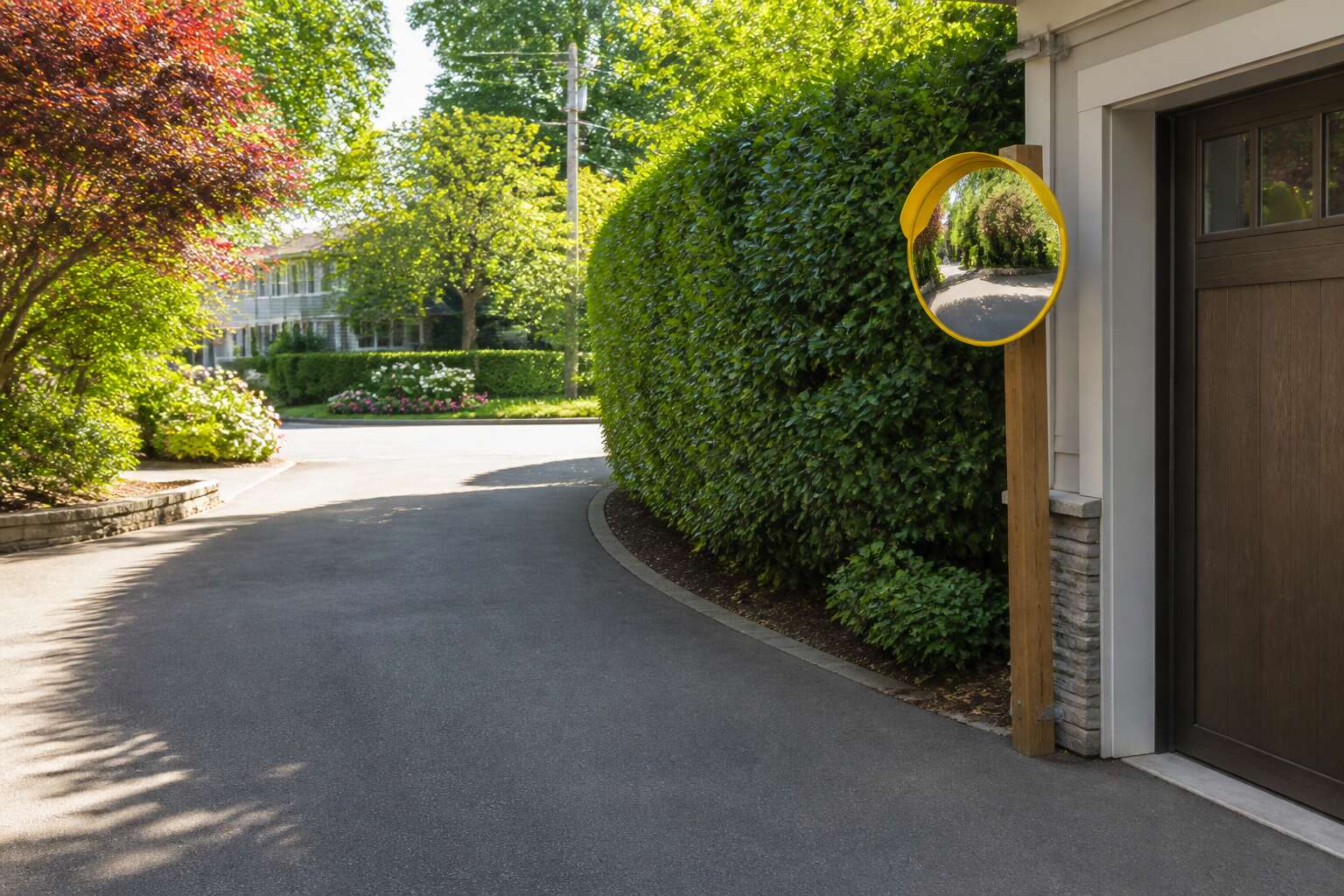
Mechanical texture solves the ground beneath the tyres, not the unseen approach. Where the entrance narrows to a single vehicle width, the blind spot driveway paving problem persists. A convex mirror mounted on the fence line offers a glimpse of movement before the car commits. Fogged acrylic units on Durban gates convinced me the cheap option is a false economy! Marine grade steel or the mirror becomes another burden.
Sensor systems work where mirrors cannot. Infrared beams across the pedestrian approach, linked to a small light inside the garage, warn of a body in the path. The wiring for blind spot driveway paving needs planning before the pour, or you chisel into fresh concrete.
Placement dictates everything:
- High on the boundary wall, away from bumper height and headlight wash
- At knee height, where children and pets move below the driver’s vanishing point
- Inside the garage, visible in the rear view mirror
Textured Pavement as a Warning for Drivers
Textured pavement speaks to the driver through the tyres before the eye registers the danger. A raised rumble strip across the pedestrian approach changes the acoustic signature of the car, and that vibration travels up through the steering column. For blind spot driveway paving, this tactile cue is the last line of defence when mirrors and sensors fail.
Concrete broom finishes offer traction, but they do not warn. The correct approach uses a deliberate change in surface profile, such as a 10 millimetre raised band of exposed aggregate set perpendicular to the vehicle’s path. The driver feels the transition and instinctively checks the mirror.
Installation matters:
- Place the textured band at least 2 metres before the pedestrian crossing zone
- Extend the band across the full driveway width to avoid wheel miss
- Use contrasting colour alongside the texture to reinforce the warning
That combination creates a physical and visual signal for blind spot driveway paving that works in both daylight and darkness.
Colored Concrete or Asphalt for Enhanced Depth Perception
Colour changes how a driver measures distance. A pale grey driveway against a pale grey pavement creates no depth cue, and the eye cannot locate the edge of the blind spot driveway paving. In South Africa, where the sun bleaches surfaces to a similar tone, this becomes a hazard. Integral colour oxides, mixed into the concrete before pouring, offer a lasting solution. A warm ochre band along the boundary gives the eye a reference point.
- Iron oxide pigments resist UV fading
- Colour on the pedestrian approach preserves contrast
- Sample patches reveal how the colour shifts under different light
Asphalt accepts colour too. A coloured slurry seal or a thin polymer overlay can be applied without excavation. The result is a distinct tonal shift that reads as a change in elevation, even when the surface is level. I have seen blind spot driveway paving where this colour shift resolved a persistent near miss at the pedestrian approach.
Regulations and Safety Standards
Local Building Codes for Driveway Visibility
In South Africa, municipal town planning schemes often specify setback distances and sight line triangles, but few homeowners realise these rules apply to driveways too. That oversight contributes to many blind spot driveway paving failures! For example, a boundary wall higher than 600 millimetres near the entrance can violate local visibility regulations before you even pour a single slab. I have seen approved plans where the architect simply ignored the sight line requirements.
Your local authority may require:
- A clear sight triangle measured from the kerb or road edge.
- Maximum fence or hedge heights within that triangle.
- A minimum driveway width based on the property’s zoning.
These standards exist to protect pedestrians, cyclists, and oncoming motorists. When you plan your blind spot driveway paving project, check the building line and sight distance guidelines first. Ignoring them can mean costly rework after an inspector flags the site. It is far simpler to adjust your design on paper than to demolish a newly paved entrance.
ADA Compliance for Accessible Driveway Design
Accessibility standards often feel like an afterthought until someone in a wheelchair or with a visual impairment actually uses your driveway. In South Africa, SANS 10400 outlines ramp gradients and manoeuvring spaces, yet I rarely see these applied to blind spot driveway paving. A gentle slope for a wheelchair user does nothing if the entrance sits behind a solid pillar.
Consider these requirements for an accessible entrance:
- A maximum cross slope of 1:50 to prevent sideways drift.
- A landing platform at the top and bottom of any ramp.
- Tactile warning surfaces where the driveway meets the pavement.
These elements change the sight line geometry substantially. When you plan blind spot driveway paving, integrate them early. A dropped kerb for a wheelchair user also shortens your stopping distance at the road edge. That forces you to widen the clear vision triangle, which is a safety win for everyone, not just those with mobility aids.
Homeowners Association Rules Affecting Paving Changes
Your homeowners association might quietly sabotage your blind spot driveway paving. In many South African estates, the architectural review committee enforces design codes that dictate driveway dimensions, paving colours, and even the height of your boundary wall. These rules often conflict with the clear vision triangle needed for a safe entrance.
Typical HOA constraints include:
- Maximum driveway width limits
- Approved paving materials and finishes
- Restrictions on mirrors, sensors, or visible markings
These regulations can override your planned sight line improvements. SANS 10400 sets minimum safety standards, but the estate’s design code may impose stricter limits. The committee’s composition changes too, so verbal approvals carry little weight. Only a written waiver ensures consistency across board turnovers.
Permit Requirements for Major Driveway Alterations
Municipal permits operate on a different schedule from communal aesthetics. Your blind spot driveway paving might impress the architectural committee, only to stall because the proposed gradient alters the public sidewalk. In many South African towns, any driveway modification that changes the verge, the curb, or the stormwater flow requires building plan approval.
Officials expect a specific checklist:
- A scaled site plan showing existing and proposed hard surfaces
- An engineer’s certificate for retaining structures over one metre
- A stormwater management statement if paving expands beyond 50 square metres
SANS 10400 informs the technical review, but municipal by-laws add another layer. Your sight line could be rejected if the drainage outlet conflicts with roadway drainage rights. Obtain written approval before ordering materials, because verbal assurances from building inspectors carry no weight.
Professional Installation and Maintenance
When to Consult a Civil Engineer or Surveyor
Professional installation matters more than most homeowners realise. A poorly executed blind spot driveway paving job can turn a minor visibility issue into a permanent hazard. Contractors who specialise in this work understand how to grade surfaces for optimal sight lines, but even they have limits.
When should you call in a civil engineer or surveyor? If your property sits on a steep slope, if drainage patterns are shifting, or if you plan to alter the driveway’s elevation significantly, get professional input before spending money on materials. A surveyor can map exact boundary lines and sight angles. An engineer can verify that your planned changes won’t destabilise the ground.
Maintenance demands attention to specific failure points:
– Cracks that collect water and obscure markings
– Faded edge lines that reduce contrast
– Settling or heaving that changes the surface angle
These issues compound quickly. A blind spot driveway paving project only remains effective when these defects are caught early.
Finding a Paving Contractor Experienced in Safety Improvements
Hiring a contractor for blind spot driveway paving requires a shift in perspective. You are not simply resurfacing concrete; you are investing in a safety system. Ask candidates to walk the property with you and explain how they plan to preserve sight lines. A contractor focused only on aesthetics might miss the subtle grading required for a clear view of oncoming traffic.
During the vetting process, look for hard evidence of past safety work.
– Request references from homes with similar slope or curve constraints.
– Ask if they use laser leveling to maintain precise surface angles.
– Verify their experience installing contrast edges and textured warning strips.
Remember, blind spot driveway paving only remains effective with a strict maintenance routine. Faded markings and settling surfaces quietly erode the safety margin you paid for. A responsible contractor will discuss the resealing schedule and offer to inspect for heaving after seasonal changes. Their willingness to stand behind the safety function of the job tells you more than any portfolio.
Cost Estimates for Visibility-Enhancing Upgrades
Professional installation costs for visibility upgrades vary widely across South Africa. Contrast edging and textured warning strips typically run between R8,000 and R25,000, while light-reflective sealants add R3,000 to R6,000. Those figures assume proper site preparation, which determines how long your blind spot driveway paving holds up.
Ongoing maintenance follows its own rhythm:
- Annual resealing: R1,500 to R4,000
- Crack repair and retexturing: R2,000 to R7,000 per visit
- Post-rain laser leveling checks: R800 to R1,500 per inspection
I have seen homeowners skip professional installation to save money, only to face premature surface failure. Settling and fading quietly erode the safety margin you originally paid for. Schedule inspections twice a year, especially after seasonal shifts, and expect to pay for quality workmanship.
Seasonal Maintenance to Preserve Sight Lines
Professional installation of blind spot driveway paving demands attention to seasonal behavior. The ground in South Africa swells and contracts with rainfall cycles, and a slab laid in winter may settle differently by autumn. No surface polish compensates for poor base preparation. The correct approach is a contractor who studies the site’s drainage patterns before pouring a single square meter.
Seasonal maintenance preserves sight lines for any blind spot driveway paving investment. When the first rains hit, silt and debris collect along the edges, obscuring the contrast markings that guide drivers. A simple checklist keeps the surface and its visibility features intact:
- Clear sediment from edge lines after every heavy storm
- Inspect for hairline cracks before they widen from moisture intrusion
- Verify that textured warning strips still provide tactile feedback
These small rituals prevent subtle deterioration from eroding the safety margin. A driveway that survives one season without attention often fails the next. Professional workmanship only holds its value when the upkeep follows the same season.
Periodic Repairs and Resurfacing for Long-Term Performance
Professional installation of blind spot driveway paving begins with the subgrade. A contractor who skips the geotechnical survey or pours on a wet base will create problems that no surface finish can correct. The foundation governs all that follows.
Periodic repairs are mandatory, not optional. Inspect once a year for spalling at the edges, faded contrast markings, and movement at expansion joints. Cracks wider than a credit card allow water to undermine the base. That water erodes the sight line integrity your design depends on!
- Seal cracks in autumn before winter rains
- Reapply high friction coatings when they feel smooth
- Repaint edge markings every second year
Resurfacing becomes necessary when repairs cover more than a quarter of the surface. A new overlay restores camber, texture, and visual contrast. This is where blind spot driveway paving shows its true value. Long term performance is a cycle, not a single event.

0 Comments