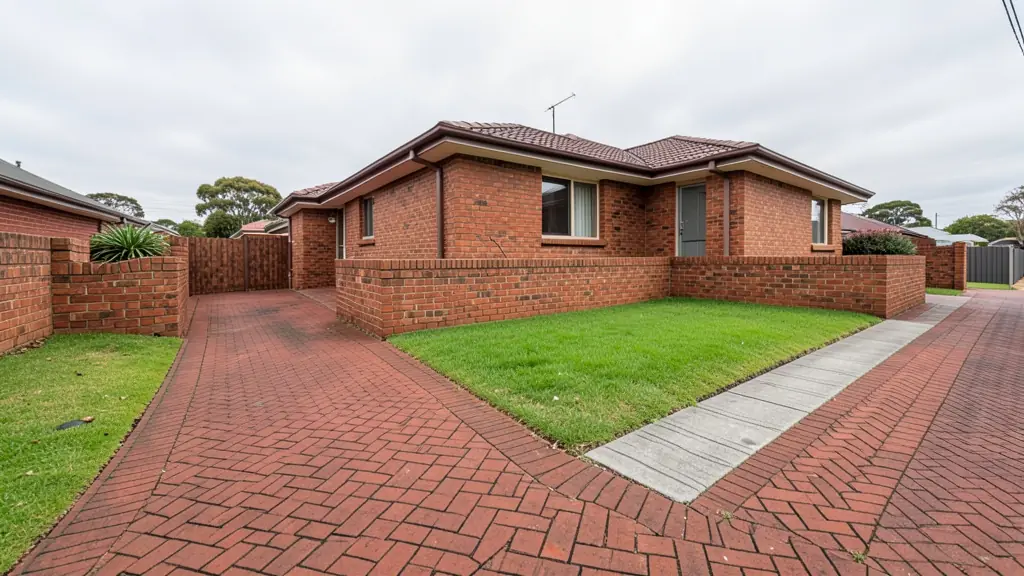
Ask for brick pavers at a yard in Germiston and the first question back is "clay or cement?" In South Africa the term covers both: fired clay pavers from a kiln, and concrete pavers pressed from cement, sand and stone. Laid on a driveway they look alike, yet they age and price differently, and the shape and thickness matter as much as the material. Choose in the order below and the quotes you collect will compare like with like.
Price guide
A Cape Town paving yard lists 50 mm bond pavers at about R220 per m² and 60 mm interlocking pavers at about R250 per m², supply only. A Lanseria factory lists cobbles and 60 mm pavers at about R260 to R280 per m², excl. VAT.
A rough guide from published South African prices. The type, thickness, quantity, delivery, the base and VAT all move it.
Is a brick paver made of clay or concrete?
| Fired clay | Concrete | |
|---|---|---|
| Colour | Fired through, holds its shade for decades | Pigment in the mix, can soften in strong sun |
| Range | Earthy reds, browns, buffs | Greys, charcoal, reds, blends, many shapes |
| Sizes | Small variation from the kiln | Very even from the mould |
| Price | Usually more per m² | Usually less per m² |
The clay pavers and cement pavers pages go deeper into each.
In what order should I choose pavers?
- What will use it. Feet only, the family car, or a pickup towing a boat trailer. The trade commonly lays about 50 mm for foot traffic, 60 mm for cars at home and 80 mm for heavy use; get the strength class from the factory in writing.
- The look. Colour, a bevelled or square edge, and the laying pattern, which you can try on the paving patterns page.
- The ground. Red clay soil in Pretoria or loose sand in Langebaan needs more base work than firm gravel; see paving sand and base.
- The budget. Last, because the first three settle most of it.
Where does each kind of paver fit best?
- Plain rectangles: paths, patios and home driveways, in almost any pattern.
- Interlocking shapes: yards and complex roads where vehicles turn and brake all day.
- Bevelled edges: patios laid by hand, where small level differences would show.
- Clay: face brick homes and older suburbs where faded grey would look wrong.
- Cobbles, slabs and stone: entrances, borders and gardens that want texture.
How do I work out how many I need?
Measure the area in square metres, splitting an odd shape into rectangles and triangles. Add a margin for cutting along walls, drains and curves. The paver calculator turns your area and paver size into a count and a pallet estimate you can put straight into a request.
Who asks for this
- Homeowners
- A driveway and paths chosen to suit the house, the cars and the soil.
- DIY weekenders
- A small patio or path where the paver choice decides how forgiving the job is.
- Estates and body corporates
- One paver family and colour across every unit, written into the complex rules.
- Builders and developers
- Pavers specified on new houses with the thickness matched to the driveway load.
- Landscapers and garden services
- Mixing clay borders, concrete fields and stone accents in one garden plan.
- Shops, offices, schools and churches
- A shop front or church entrance that takes daily foot and car traffic.
- Farms, lodges and venues
- A lodge entrance or packshed apron that has to handle tractors and guests.
- Municipal and public works
- Sidewalks, taxi ranks and municipal squares paved to an engineer's specification.
Frequently asked questions
Are brick pavers and paving bricks the same thing?
Mostly, yes. Yards use both names for any small paving unit. Some buyers mean only fired clay when they say "brick", so name the material in your request to avoid a quote for the wrong one.
Which lasts longer, clay or concrete pavers?
Both can last decades on a sound base. Clay keeps its colour; concrete tends to lighten on the surface. A paving job rarely fails because of the paver itself: soft ground, weak compaction or missing kerbs cause most problems.
Can I mix clay and concrete pavers on one job?
Yes, a clay border round a concrete field is common. Check the two thicknesses match, or the bedding sand must make up the difference.
Who will quote me for brick pavers?
The factories, yards and paving teams that cover your suburb. Each one gets your request from us and sends its own price straight to you. We make, lay and sell no pavers ourselves.
Related topics
Work it out first
- Paver calculatorArea, paver size, joint and cutting allowance: pavers per m², the count with cuts, pallets to order and the m² each pallet covers
- Paving base calculatorArea, traffic and sand depth: base gravel in loose m³ and tonnes, bedding sand in m³ and tonnes, and how many truck loads to order
- Paving cost calculatorYour own quoted rates for pavers, base, labour, edging, removal and delivery: each line, the total with or without VAT, and the rand per m² laid