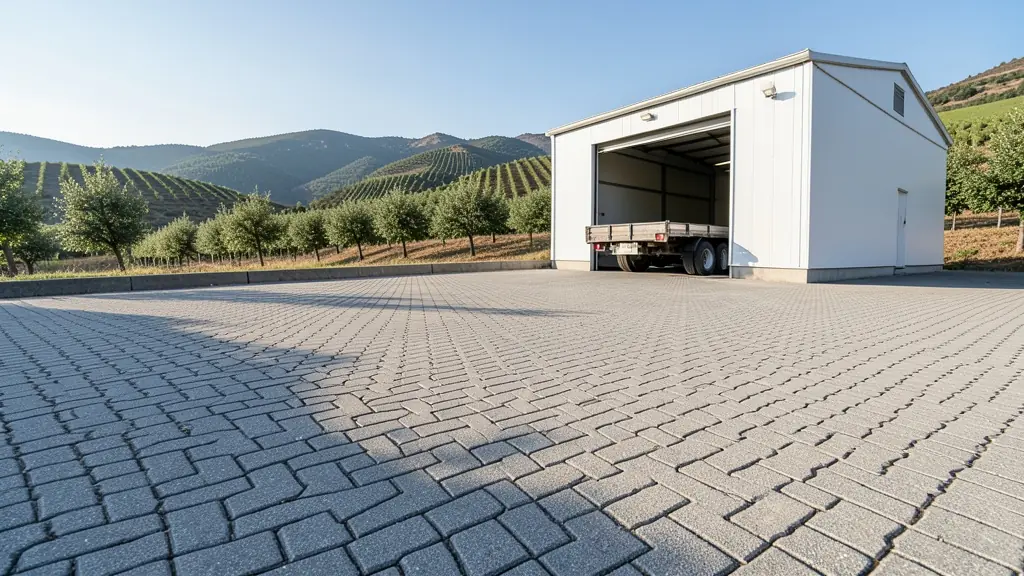
A rectangle has four straight sides, so when a loaded pickup brakes or turns its wheels on the spot, a loose one can twist in its joint. Interlocking pavers have wavy, zigzag or I-shaped sides that key into their neighbours, so the load spreads across several pavers instead of one. They are the workhorse of loading yards, filling stations and complex roads, and they take some planning at the edges.
Price guide
A Cape Town paving yard lists 60 mm interlocking pavers at about R250 per m², supply only. A Cape Town factory lists 60 mm interlockers at about R5 to R6 each, incl. VAT, and a Gauteng seller lists a 500 paver pallet at about R1,357, incl. VAT.
A rough guide from published South African prices. The type, thickness, quantity, delivery, the base and VAT all move it.
What shapes do interlocking pavers come in?
- Zigzag or wave: a rectangle with wavy long sides. Many yards call these "crazy pavers".
- I-shape: narrow in the middle and wide at the ends, also sold as dumbbell or dog bone.
- Other keyed shapes: some factories press their own, often with matching edge and end pieces.
Count per m² differs with the shape, so order by area and let the factory convert.
How do they resist turning and braking cars?
Each paver touches its neighbours on more faces and at angles, so it cannot rotate or slide alone. That only works with tight sand filled joints, a final pass with a plate compactor and a kerb or edge restraint holding the field in. On a soft or wet base they still sink: the shape keys pavers to each other, not to the ground. A church parking lot in Polokwane on soft clay soil needs its base sorted before any paver shape can help.
Why do contractors like them on big areas?
They go down in simple straight courses with no pattern to think about, so a team covers a warehouse apron or an estate road quickly, and on large sites they can be laid in clamps by machine. The edges are the catch: zigzag ends leave triangular gaps against a straight kerb. Ask whether the factory makes end or half pieces and whether they are in the price, or whether the layer will cut and fill.
How do interlocking pavers look at a house?
Practical, and a little industrial. The wavy joints make a busy surface that can crowd a small townhouse driveway. Many homeowners get the same locking effect from rectangles in herringbone; compare the two on paving patterns and driveway paving. For estate roads and parking lots, see commercial paving.
Who asks for this
- Homeowners
- A double driveway where two cars reverse and turn on the same spot daily.
- DIY weekenders
- A straight run of zigzag pavers with no pattern to plan, finished with end pieces.
- Estates and body corporates
- Complex roads and visitor parking that take refuse trucks every week.
- Builders and developers
- Site entrances and loading bays that must handle delivery trucks from day one.
- Landscapers and garden services
- A service road behind a garden where trailers and tractors pass.
- Shops, offices, schools and churches
- Filling station forecourts, warehouse aprons and shopping centre parking.
- Farms, lodges and venues
- A packshed or dairy yard where tractors and loaded trailers turn all day.
- Municipal and public works
- Bus lanes, taxi ranks and municipal depots designed by an engineer.
Frequently asked questions
Are crazy pavers the same as crazy paving?
No. Crazy pavers are factory zigzag shapes laid in rows. Crazy paving is irregular broken stone or slabs fitted like a puzzle, covered on flagstone paving.
Are interlocking pavers good on a sloping driveway?
Yes, they creep downhill less than loose rectangles. They still need a solid kerb at the bottom, a concrete strip across the slope to stop the field sliding, and a channel to catch water before it scours the sand out of the joints.
Can interlocking pavers be lifted and relaid?
Yes. The first one is hard to prise out because it is keyed on all sides; start at a cut piece along the edge.
What thickness do interlocking pavers come in?
Commonly 60 or 80 mm. Yards that take trucks usually go thicker, and an engineer sets the spec for a public road.