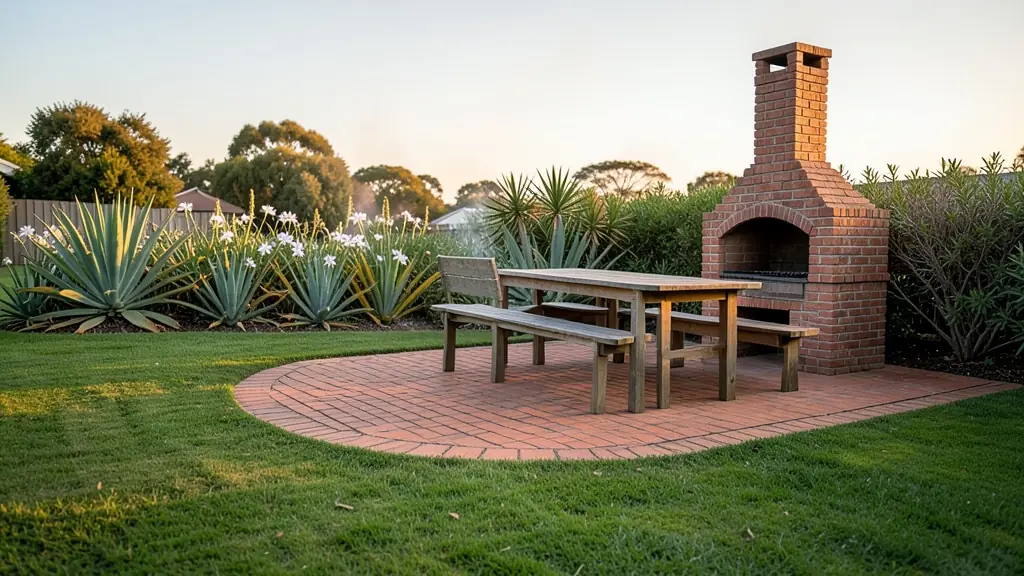
Garden paving is planned around how people use the space: where the table and chairs go, how you carry a tray from the kitchen to the braai, which line the dog has already worn across the lawn. Because only feet use it, thinner pavers and a lighter base usually do. What matters more is the shape, the levels, heat near the fire and the edge where paving meets grass or a bed.
Price guide
A Cape Town paving yard lists bond pavers at about R390 per m² supplied and laid, square eco pavers at R350, three piece flagstones at R400 and large stepping slabs up to about R450. Supply only, the same pavers are about R110 to R310 per m².
A rough guide from published South African prices. The type, thickness, quantity, delivery, the base and VAT all move it.
How big should a patio or path be?
Set out the actual table with the chairs pushed back as if people are sitting, then add room to walk behind them. Around a braai, leave space for the person cooking plus a route that does not pass through the smoke. A path that takes a wheelbarrow, or two people side by side at the front door, needs more width than one to the washing line. Squares and rectangles of whole pavers waste the least; curves add cuts. The paver calculator gives the count with a cutting allowance.
Steps, levels and the fall from the house
The finished patio should sit below the damp course of the house wall, never against or over it, and fall gently away so rain runs into the garden. On a sloping garden in, say, Pinetown, break the area into terraces joined by steps of pavers set on a concrete footing. Keep every riser the same height; one odd step is where people trip.
Paving near a braai, boma or fire pit
- Concrete pavers right beside open flames can crack and flake; fired clay takes the heat better.
- Line a fire pit with firebricks and ring it with clay pavers.
- Fat drips by the braai stain concrete, so a darker paver or a sealed strip helps.
- A boma looks right with pavers laid in a circle pattern round the fire.
Where paving meets lawn and flower beds
Set the edge row in concrete slightly below the lawn so the mower runs over it, and kikuyu runners are cut before they creep into the joints. Raise the edge of a bed a little so soil does not wash onto the paving after a storm. Keep paving back from big trees, whose roots lift it within a few years. For a light path across lawn, slabs as stepping stones are quicker.
Who asks for this
- Homeowners
- A patio outside the lounge doors with room for a table and a braai.
- DIY weekenders
- A straight washing line path, or a small square patio, laid over two weekends.
- Estates and body corporates
- Communal braai areas and paths between units, laid to the complex's chosen colour.
- Builders and developers
- A small covered patio and a front path finished as part of a new house.
- Landscapers and garden services
- Paths, terraces and a boma designed and laid together with the new planting.
- Shops, offices, schools and churches
- A coffee shop courtyard or school quad paved for tables and foot traffic.
- Farms, lodges and venues
- A lodge boma with seating round a fire pit, paved in fired clay.
- Municipal and public works
- Park paths and picnic areas paved where grass has worn away to dust.
Frequently asked questions
Can garden paving go straight onto sand?
Not without a base. Foot traffic needs less than a driveway, but loose soil under the sand still settles into hollows, especially where the sprinkler wets it.
Bricks or slabs for a patio?
Paving bricks follow curves and tolerate small movement; large slabs lay faster and look modern but crack on a soft base. For a stoep, slabs often match the house better.
How do I keep a patio cool in summer?
Choose a lighter colour such as sand or buff, and plan shade from a pergola or tree on the west side. Charcoal pavers in full afternoon sun get too hot for bare feet.
Can a small garden be paved completely?
It can, but leave beds or gaps where rain can soak in, or the water from the whole yard ends up at one corner or at the neighbour's wall.