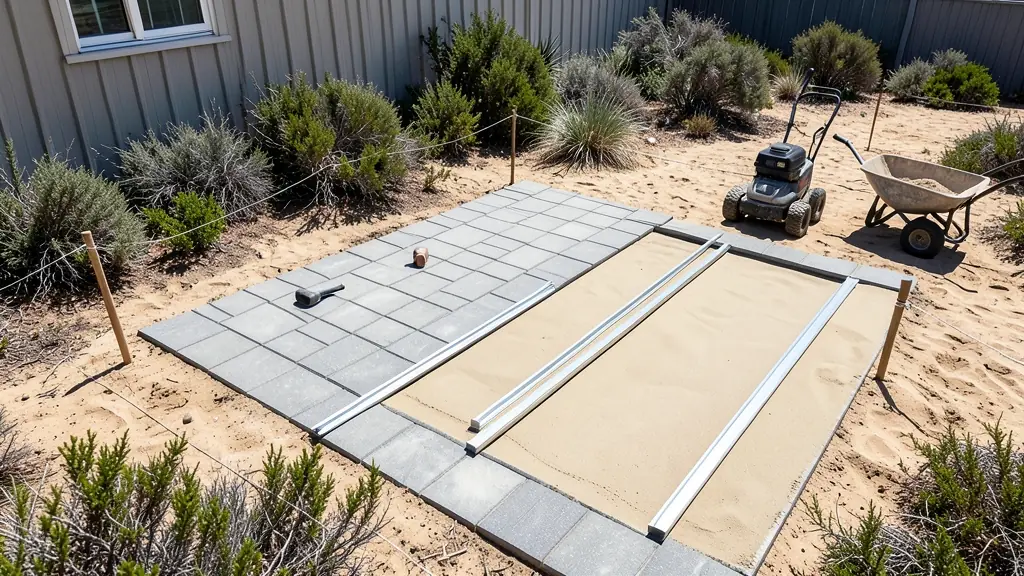
Laying a patio or garden path yourself is a fair weekend project if you work in the right order and do not hurry the part nobody sees. This is the sequence most paving teams follow, scaled down for a DIY job carrying foot traffic. A driveway is harder: the base is deeper and every mistake shows under the car, so many owners hire a paving contractor for that.
Price guide
A Cape Town paving yard lists labour only paving at about R170 per m², drainage sand and cement included. For a DIY job, a Cape Town factory lists bond pavers at about R4.50 each and building sand at about R30 a bag, incl. VAT.
A rough guide from published South African prices. The type, thickness, quantity, delivery, the base and VAT all move it.
What you need before you start
Pegs, builder's line, a spirit level, a long straight edge, two steel pipes as screed rails, a spade, a wheelbarrow, a rubber mallet and a splitter or grinder for cuts. Hire a plate compactor by the day. Wear hearing and eye protection, a dust mask when cutting, gloves and boots. Work out pavers with the paver calculator and base and sand with the base calculator. A pallet of pavers often weighs over a tonne, so let the crane truck put it down where you need it.
Laying paving step by step
- Peg out the area, mark the finished level and a fall away from the house. Look for pipes and cables before digging.
- Dig out enough for the base, the sand and the paver. Remove roots and soft patches.
- Spread the base in layers, dampen each one and compact it.
- Fix an edge restraint along at least one side.
- Lay the rails, spread bedding sand and pull the straight edge across. Stay off it once screeded.
- Lay pavers from the fixed edge, kneeling on laid pavers, joints tight, checking the line every few rows.
- Cut the edge pieces, avoiding thin slivers.
- Finish the edges, sweep in jointing sand and compact, then sweep and compact again until the joints are full.
Mistakes that show after the first rains
- Bedding sand spread thick to hide a bumpy base
- Plaster sand used for bedding; the sand and base page explains why it fails
- No restraint, so the edge rows walk outwards
- Water draining towards the house
Using a plate compactor safely
Ask the hire shop to show you the controls. The machine is heavy, so lift it with two people. It is loud and shakes your hands: hearing protection, boots and regular breaks. Run it outdoors only, keep children and pets indoors, and put a rubber mat under the plate when you go over pavers.
Who asks for this
- Homeowners
- A first patio or path laid by the owner with a hired compactor.
- DIY weekenders
- A weekend path to the garden shed, laid on a compacted base with edges.
- Estates and body corporates
- A small courtyard paved by an owner once the body corporate has approved it.
- Builders and developers
- A handyman team laying small patios on new units after the main work.
- Landscapers and garden services
- Garden services crews laying short paths and bin areas beside planting jobs.
- Shops, offices, schools and churches
- A church or school working party paving a path with donated pavers.
- Farms, lodges and venues
- A farm worker team paving a path from the farmhouse to the vegetable garden.
- Municipal and public works
- Community projects laying short footpaths where a contractor sets the base and edges.
Frequently asked questions
How long does a small DIY patio take?
Allow a weekend for digging and the base, and another for laying, cutting and jointing on a patio of about 15 m².
How deep should I dig for a patio?
Commonly the paver thickness plus the sand bed plus a base layer that is often around 100 mm under foot traffic. Soft or clay soil needs more.
Can I lay pavers on an old concrete slab?
If the slab is sound and falls the right way, pavers can go on a thin sand or mortar bed. Water must still have a way off the slab.
Do I really need a plate compactor?
Yes. Hand tampers do not settle the base or bed the pavers evenly, and the paving sinks in patches later.