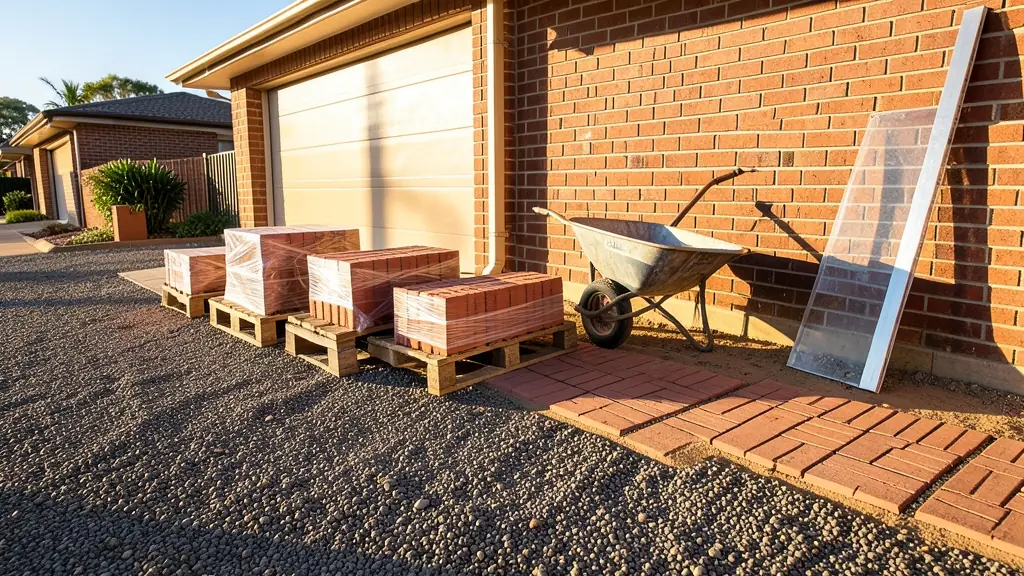
Ordering pavers is a sum of two parts: how many fit in a square metre once the joint is counted, and how many get cut or broken on the way. The trade rounds a standard brick to about 50 per m², which is close but not exact. This calculator works from the laid size of your paver and adds a cutting allowance, then turns the total into pallets. Sizes and thicknesses of the common brick are on paving bricks.
How many paving bricks per square metre?
Divide one million by the laid size in millimetres: the paver's length plus the joint, times its width plus the joint. A 200 x 100 mm brick with a 2 mm joint comes to about 48.5 per m², which is why yards quote about 50 and why a big order counted at 50 leaves a little spare. A larger rectangle or a slab drops the count fast, so pick the size you will actually buy or type your own from the factory's sheet. For the example area of 8 x 5 m, that is about 1,940 bricks before any cuts.
Which cutting allowance should I use?
The example uses 7%, the figure for herringbone at 90 degrees. A plain stretcher bond on a square patio needs less; herringbone at 45 degrees, curves, manholes, steps and many corners need more, because every cut leaves an offcut too short to use. The paving pattern planner gives the allowance for each pattern. Order the spare with the main batch: pavers from a later batch can differ in colour, and a few extra on the shelf make repairs easy.
What the pallet figure depends on
The 500 per pallet in the widget is an example, not a count from any factory. Counts change with the size, the thickness and how each factory stacks, so ask for the number per pallet and the m² it lays, in writing. The board rounds the pallets up; ask whether a part pallet can be bought or whether full pallets go back for a refund of the deposit. A full pallet is heavy and comes off with a crane truck or a forklift, so check the truck can reach the spot. Paving bricks per pallet covers deposits and storing them on site.
Frequently asked questions
Should I measure the area including the border?
Yes, if the border is the same paver. If it is a different kerb or a soldier course in another colour, take its width off and count it separately.
What joint should I type?
Pavers laid tight with jointing sand swept in usually sit about 2 to 3 mm apart. Many have small spacer nibs on the sides that set the gap for you.
Does it work for an odd shaped area?
Split it into rectangles, work out each one's m² and type the sum in the m² field. Add a little more cutting allowance for the extra edges.
Who will quote me for the pavers?
Independent paver factories and building material yards that deliver to your area, not us: we make and sell nothing. Ask each for the count per pallet with the price.
Read more
More tools
- Paving base calculatorArea, traffic and sand depth: base gravel in loose m³ and tonnes, bedding sand in m³ and tonnes, and how many truck loads to order
- Paving cost calculatorYour own quoted rates for pavers, base, labour, edging, removal and delivery: each line, the total with or without VAT, and the rand per m² laid
- Paving fall calculatorThe drop needed for water to drain off a patio or driveway, and how steep a sloping driveway is in % and as 1 in x, with a warning when it is steep
- Paving pattern plannerChoose a pattern and see it drawn, the cutting allowance and extra pavers, roughly how many edge cuts, how well it locks under cars and what to watch
- Sealer and paint calculatorArea, product, coverage and coats: litres per coat, extra for porous pavers on the first coat, the total litres and the tins to buy
- Paving quote comparisonThree paving quotes, the lines each includes and what the missing ones cost: each quote's price made like for like, the lowest total and the questions to ask