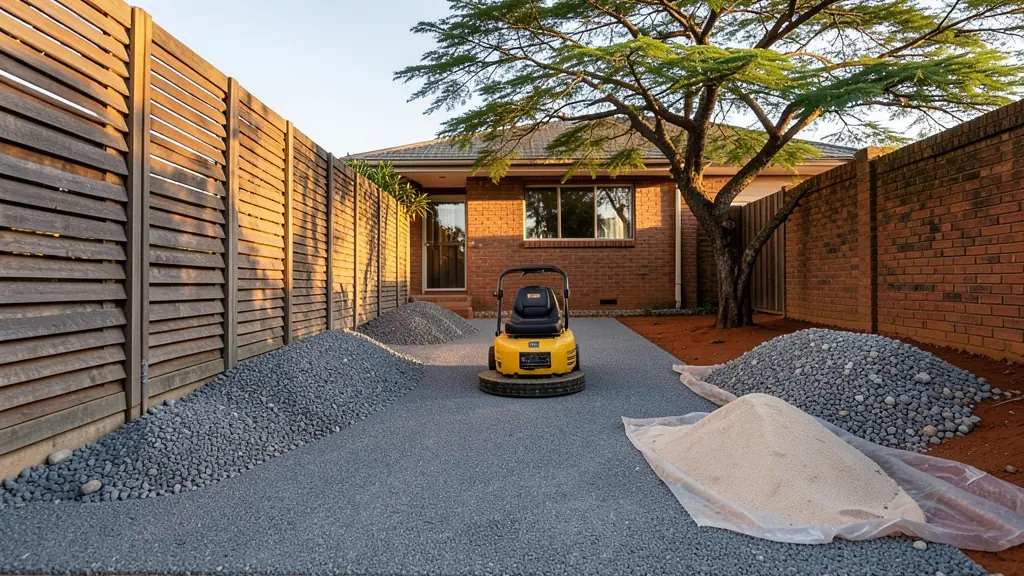
Most paving that sinks or rocks failed underneath, in a base that was too thin, too soft or never compacted. Ordering the right amount is the first step to getting it right. This calculator turns an area and a typical depth for its traffic into loose gravel and bedding sand, by volume and by weight, and counts the truck loads. What each layer does, and why building sand is wrong for bedding, is on paving sand and base.
How deep should a paving base be?
The depths in the list are what home paving commonly gets, not a design:
- about 100 mm compacted under paths, patios and pool surrounds
- about 150 mm under a home driveway
- about 200 mm or more for bakkies, delivery vans and a busy complex
The soil decides the rest. Clay that swells when wet, filled ground or a wet corner can need more, or a different approach. An engineer designs roads, parking for trucks and anything with heavy, constant traffic. See driveway paving for the turning spot where a thin base shows first.
Why the board orders more gravel than the hole holds
Loose gravel shrinks when it is compacted, so the board multiplies the compacted volume by about 1.3. For the example 40 m² driveway at 150 mm, 6 m³ compacted becomes about 7.8 m³ loose, a little over 14 tonnes at about 1.8 t per m³. Compact it in layers, not all at once: a plate compactor only reaches so deep. Sand is converted at about 1.5 t per m³. Yards sell by the m³ or by the tonne, so ask which, and use the tonnes or the cubes to match.
What the loads do not include
The truck size is an example; ask the yard what its trucks carry and whether a small load costs extra. The board does not count soil dug out to make room for the base, which is often the bigger load and has to go somewhere, nor the jointing sand swept in at the end (a few bags for a driveway). Edge restraints and a fall to drain water away from the house matter as much as depth: check the drop with the paving fall calculator.
Frequently asked questions
Can I use building sand for the bedding layer?
It is a common mistake. Fine plaster or building sand holds water and lets pavers sink. Ask the yard for sand sold for paving bedding.
How thick should the bedding sand be?
Commonly about 25 to 30 mm, screeded loose and level. It is a bed to set the pavers in, not a way to fix low spots in the base.
Do I need a base on hard, dry ground?
Even firm ground moves when it gets wet. A compacted base spreads the load and lets water run off. Skipping it is where most cheap jobs go wrong.
Who will quote for the base material?
Building material yards and paving contractors near you, not us: we supply nothing. Ask for the material by name, the volume and the delivery in writing.
Read more
More tools
- Paver calculatorArea, paver size, joint and cutting allowance: pavers per m², the count with cuts, pallets to order and the m² each pallet covers
- Paving cost calculatorYour own quoted rates for pavers, base, labour, edging, removal and delivery: each line, the total with or without VAT, and the rand per m² laid
- Paving fall calculatorThe drop needed for water to drain off a patio or driveway, and how steep a sloping driveway is in % and as 1 in x, with a warning when it is steep
- Paving pattern plannerChoose a pattern and see it drawn, the cutting allowance and extra pavers, roughly how many edge cuts, how well it locks under cars and what to watch
- Sealer and paint calculatorArea, product, coverage and coats: litres per coat, extra for porous pavers on the first coat, the total litres and the tins to buy
- Paving quote comparisonThree paving quotes, the lines each includes and what the missing ones cost: each quote's price made like for like, the lowest total and the questions to ask