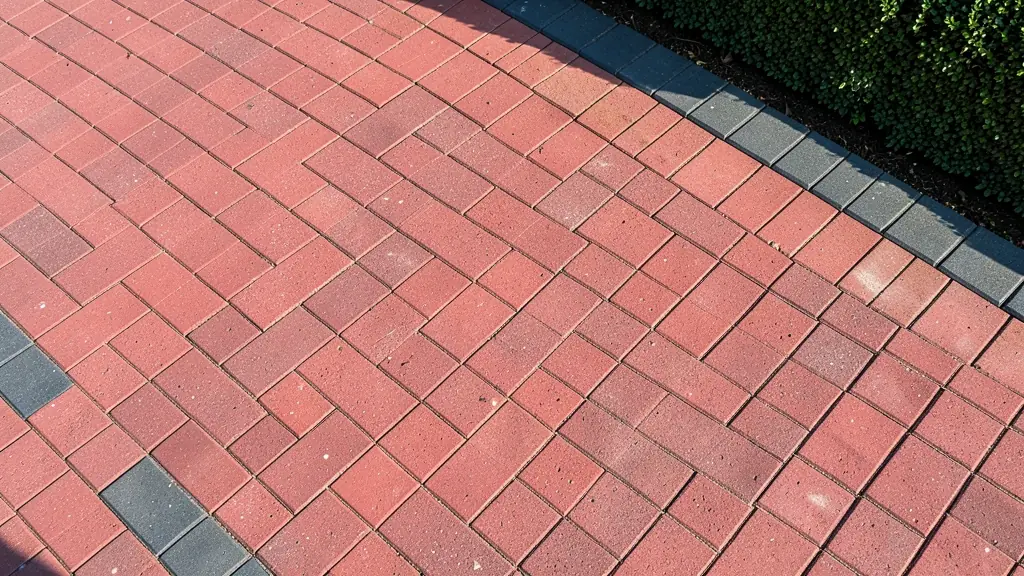
The pattern is the one choice that changes both how paving looks and how it behaves. The same rectangular paver can go down in rows, in pairs or in a zigzag, and under a car the difference shows within months: some patterns let pavers rotate and drift, others hold each brick on several sides. Pattern also decides how many cuts the edges take, and that turns up in the labour and the waste.
Price guide
A Cape Town paving yard lists 50 mm bond pavers at about R390 per m² and 60 mm interlockers at about R420 per m², supplied and laid. No source opened prices a herringbone or other pattern separately, so ask whether the quote includes cutting.
A rough guide from published South African prices. The type, thickness, quantity, delivery, the base and VAT all move it.
The common paving patterns compared
| Pattern | Under cars | Cutting |
|---|---|---|
| Stretcher bond (rows) | Fair if rows run across the traffic | Low |
| Basket weave (pairs) | Weak, the pairs turn | Low |
| Herringbone, square to the edge | Strong | Medium |
| Herringbone on the diagonal | Strongest | High, every edge cut |
| Circle or fan | Foot traffic mainly | Highest |
Try them on your own area in the pattern planner.
Why herringbone suits a driveway
When a car brakes or its wheels turn on the spot, each paver gets pushed sideways. In rows, a whole line can slide; in basket weave, a pair can twist. In herringbone, every brick butts against neighbours running the other way, so the push is shared across many pavers. Interlocking shapes get a similar grip with a simpler layout.
Borders, soldier courses and modern patterns
A soldier course is a row of pavers turned end on along the edge. It frames the field and gives the cut pieces something straight to meet, though it still needs a kerb or haunch behind it. A charcoal border round a sand field, or bands of cobbles across a long drive, break up a big area. Modern paving designs lean towards long, narrow pavers in plain rows, large slabs in a stack bond, or mixed sizes in a random layout, usually in one or two greys.
How the pattern changes the price
Each cut takes time and breaks a paver into an offcut. Diagonal herringbone needs a larger waste allowance than rows, and circles need either special kit pieces or a lot of tapered cutting. Two colours mean two orders to keep apart on site. Ask each quote to name the pattern, so a price for rows is not compared with one for diagonal herringbone. On a small, awkward area such as a narrow side passage, a simple layout often saves more in labour than any difference in paver price.
Who asks for this
- Homeowners
- Picking between herringbone and basket weave for a driveway with a patio beside it.
- DIY weekenders
- Keeping a stretcher bond path simple so there are few cuts to make.
- Estates and body corporates
- An entrance in diagonal herringbone with a contrasting border, as the HOA requires.
- Builders and developers
- One pattern and colour across a development so every driveway reads the same.
- Landscapers and garden services
- A circle of pavers round a fire pit joined to a straight path.
- Shops, offices, schools and churches
- A shopping centre walkway with colour bands that guide people to the doors.
- Farms, lodges and venues
- A lodge entrance with cobble bands across a long paved approach road.
- Municipal and public works
- Town square paving where patterns mark crossings, seating areas and routes.
Frequently asked questions
Can the patio and the driveway use different patterns?
Yes. Run a soldier course where they meet so the change looks planned, for example basket weave on the patio and herringbone where the cars go.
Is basket weave a poor choice for a driveway?
For a busy driveway, generally yes, because the pairs work loose under turning tyres. It is fine on a path, a stoep or a patio.
Does a 3D pattern work on a driveway?
The optical pattern comes from colour, not shape, so it holds as well as the layout it is laid in. Sharp contrasts do show tyre marks and dust.
Do I need a different paver for herringbone?
No. The ordinary rectangular paver is made for it. Odd sizes from a second batch spoil the pattern quickly, so order all at once.
Related topics
Work it out first
- Paver calculatorArea, paver size, joint and cutting allowance: pavers per m², the count with cuts, pallets to order and the m² each pallet covers
- Paving pattern plannerChoose a pattern and see it drawn, the cutting allowance and extra pavers, roughly how many edge cuts, how well it locks under cars and what to watch