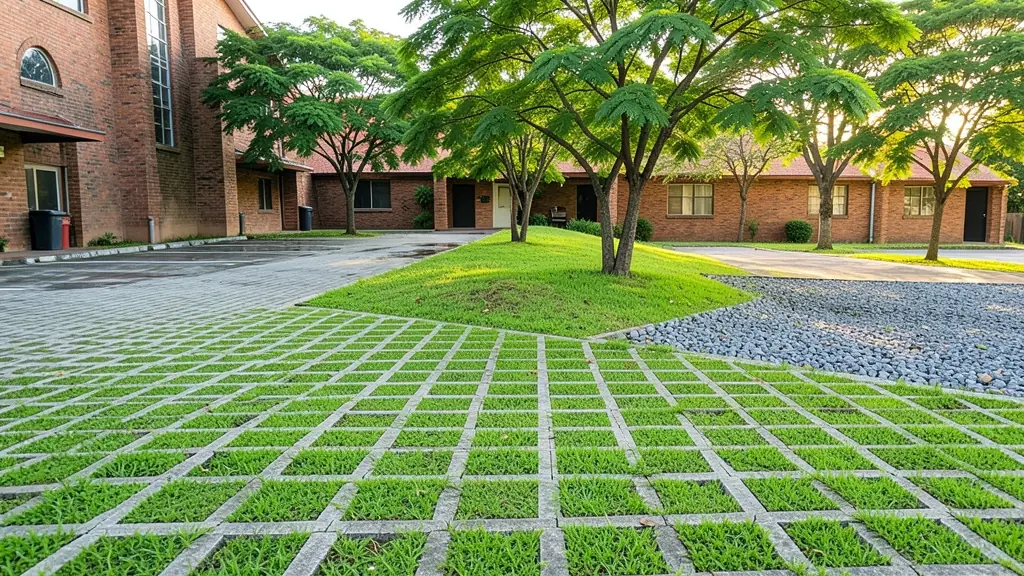
Grass block pavers are concrete blocks with open cells, laid so that soil and grass, or gravel, fill the holes. The concrete ribs carry the wheels; the cells let rain soak into the ground instead of racing off a hard surface into the street. That makes them a favourite for overflow parking at a church in Polokwane, a farm stall lay-by, a bank beside a driveway in Westville, or a fire lane that should still look like lawn.
Price guide
A Kempton Park paving supplier lists large 600 x 400 mm concrete grass blocks at about R89 each in Gauteng, R95 in Cape Town and R109 in Durban, and smaller 400 x 216 mm grass blocks at about R34 each.
A rough guide from published South African prices. The type, thickness, quantity, delivery, the base and VAT all move it.
Concrete grass blocks or plastic grids?
- Concrete grass blocks: heavy and rigid, they take regular parking, and the ribs show between the grass.
- Plastic grids or plastic pavers: light honeycomb panels that clip together and go down quickly by hand; the grass hides them almost completely, but they need a well compacted base and can shift under tight turning.
- Permeable pavers: solid pavers with spacer lugs and stone chip joints, for a paved look that still drains.
Will the grass actually grow in the cells?
Only where it gets sun and water. Under a carport, in the shadow of a wall or where a car stands all day, the grass dies and the cells fill with bare soil. Use a runner grass that spreads, a sandy topsoil in the cells, and water it through the first summer. The blocks need mowing like a lawn, and through a Highveld winter they look brown for months. Where those conditions cannot be met, fill with gravel.
Gravel fill instead of grass
Crushed stone in the cells drains just as well, needs no watering and looks the same in July as in January. It suits a parking bay used every day. Tyres flick some chips out, so top up once or twice a year, and choose an angular stone that locks into the cell rather than round pebbles that roll.
Slopes, parking and the base underneath
On a bank, grass blocks hold the soil against washing away while roots grow in. For parking, the base matters as much as under solid paving: compact in layers, fit edge restraints so the blocks cannot spread, and have an engineer specify a busy car park or a fire engine route. Check how steep the area is with the fall calculator, and see commercial paving for larger lots or driveway paving for home drives.
Who asks for this
- Homeowners
- An extra parking bay on the lawn or a grassed strip beside the main driveway.
- DIY weekenders
- Plastic grid panels for a caravan or trailer spot laid on a weekend.
- Estates and body corporates
- Visitor parking and fire lanes that stay green and soak up summer storms.
- Builders and developers
- Parking areas on new developments where stormwater must soak in on site.
- Landscapers and garden services
- Grassed banks held by blocks and lawn lanes that carry the odd vehicle.
- Shops, offices, schools and churches
- Overflow parking for churches, schools and sports clubs used a few days a week.
- Farms, lodges and venues
- Wedding venue parking, farm stall lay-bys and lodge tracks across lawn.
- Municipal and public works
- Embankments, stormwater channels and park parking where run off must be cut.
Frequently asked questions
Is permeable paving the same as pervious paving?
The two words describe one idea: a surface that lets water pass into the ground. Ask how the base below will store and drain that water, because dense red clay soil, as found round Pretoria, takes it in slowly.
Are grass blocks comfortable to walk on?
Not very, in heels or bare feet. Plan a path of solid pavers from the parking bays to the door and keep the blocks for the wheels.
How do I mow grass blocks?
Keep the soil in the cells just below the top of the ribs and set the mower high enough to clear the concrete, or the blades blunt quickly.
Who will quote me for grass block pavers?
Factories pressing open cell blocks, yards selling plastic grids, and landscapers or paving teams who have built grassed parking close to you. Their prices come straight to you, since this site supplies no blocks and does no work.
Related topics
Work it out first
- Paver calculatorArea, paver size, joint and cutting allowance: pavers per m², the count with cuts, pallets to order and the m² each pallet covers
- Paving base calculatorArea, traffic and sand depth: base gravel in loose m³ and tonnes, bedding sand in m³ and tonnes, and how many truck loads to order
- Paving cost calculatorYour own quoted rates for pavers, base, labour, edging, removal and delivery: each line, the total with or without VAT, and the rand per m² laid