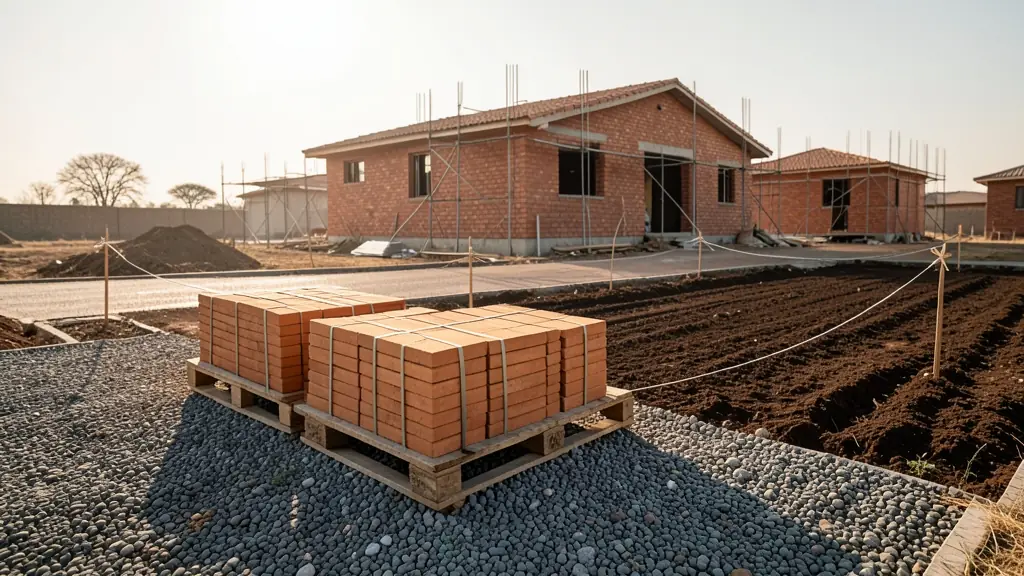
Most paving in South African yards and driveways is laid with one humble shape: a rectangle whose length is double its width. That plain paving brick is cheap to make, easy to stack and fits any pattern a contractor can draw. Knowing its size, how many make up a square metre and where half bricks help lets you check a supplier's count before you pay for a pallet you do not need.
Price guide
A Cape Town factory lists 200 x 100 mm grey bond pavers at about R4.50 each and colours at R5.50, incl. VAT. A Cape Town paving yard lists 50 mm bond pavers at about R220 per m² and 60 mm interlockers at R250 per m², supply only.
A rough guide from published South African prices. The type, thickness, quantity, delivery, the base and VAT all move it.
What size is a standard paving brick?
The face is nominally 200 x 100 mm, and the common thicknesses are 50, 60 and 80 mm, picked by the traffic it will carry. The 2 to 1 ratio is the whole trick: two bricks side by side make a square, so basket weave, stretcher bond and herringbone all close neatly without odd gaps. Factories can differ by a millimetre or two, so take every brick for one area from one supplier.
How many paving bricks go into a square metre?
One square metre divided by 0.02 m² per brick gives 50. Sand joints of a few millimetres bring the laid figure closer to 48 or 49, so ordering on 50 builds in a little spare before cuts.
| Job | Area | Bricks at 50 per m² |
|---|---|---|
| Side path | 12 m² | 600 |
| Single driveway | 36 m² | 1,800 |
| Double driveway and turning area | 80 m² | 4,000 |
Add more for a 45 degree pattern or curved edges. The paver calculator works in the cutting allowance for you.
What are paving half bricks for?
A half brick is 100 x 100 mm. In stretcher bond every second row starts with one, so the edge finishes straight against a wall or kerb without a saw. Some factories press halves; others leave you to split full bricks with a bolster or a brick saw. Ask whether halves are sold by count or by the m², and order them with the full bricks so the colour matches.
How are paving bricks counted, stacked and delivered?
Yards price per brick, per thousand or per m², and stack them in strapped cubes on pallets. How many sit on one pallet depends on the thickness and the factory, so ask; the paving bricks pallet page explains why. A crane truck usually sets the pallets down, so pick a firm, flat spot close to the work, off new lawn and clear of the water meter.
Who asks for this
- Homeowners
- The driveway, the path to the washing line and the area round the braai.
- DIY weekenders
- A stretcher bond path laid over a weekend with halves to finish the edges.
- Estates and body corporates
- Replacement bricks matched to the size already used on the complex roads.
- Builders and developers
- A set count per house in the bill of quantities, delivered with the roof tiles.
- Landscapers and garden services
- Rectangles laid as edging strips between lawn, beds and gravel.
- Shops, offices, schools and churches
- Customer parking bays in front of a small shop or doctor's rooms.
- Farms, lodges and venues
- A path from the farmhouse to the sheds that stays clean in the rains.
- Municipal and public works
- Pavements and school entrances where broken bricks are easy to replace.
Frequently asked questions
Is a 60 mm paving brick strong enough for my driveway?
For ordinary cars at a house, 60 mm on a well compacted base is the usual choice. If a builder's truck or a caravan will stand on it, ask about 80 mm, and get the strength class confirmed on the quote.
Which pattern suits a rectangular paving brick?
Any of them. Herringbone holds best where cars turn; stretcher bond is quickest for a path. Compare them on the paving patterns page.
Can I top up an old driveway with new paving bricks?
Yes, but the new ones will be brighter and may differ slightly in size. Use them in one area, such as a new parking bay, rather than scattered through the old field.
Should I order spare paving bricks?
Keep a few dozen from the same batch for later repairs after a plumber or a tree root lifts a patch.
Related topics
Work it out first
- Paver calculatorArea, paver size, joint and cutting allowance: pavers per m², the count with cuts, pallets to order and the m² each pallet covers
- Paving pattern plannerChoose a pattern and see it drawn, the cutting allowance and extra pavers, roughly how many edge cuts, how well it locks under cars and what to watch