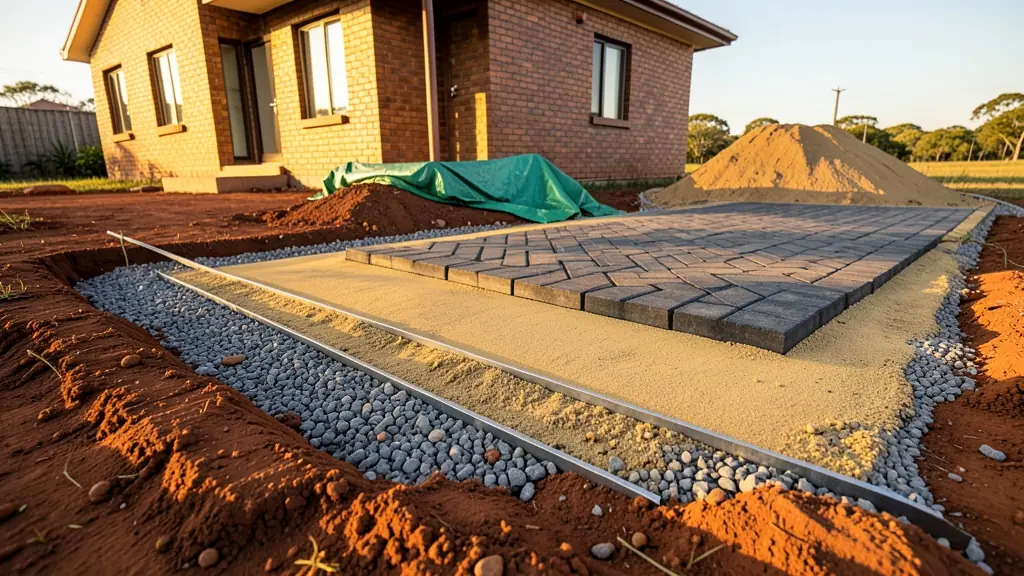
Lift a sunken paver in an old Pretoria driveway and you seldom find a broken brick. You find red clay that turned to porridge in a summer storm, a thin skim of builder's rubble, or plaster sand that has squeezed out from under the joints. The pavers are only the top layer. Below them sit three more, each with its own material and its own job, and most paving failures start in one of them.
Price guide
A Pretoria North supplier lists building sand at about R510 per m³ collected and river sand at R780, and a Cape Town supplier lists G5 sub base at about R880 for one cube delivered. A Pretoria sand mine lists building sand at about R400 per m³, excl. VAT.
A rough guide from published South African prices. The type, thickness, quantity, delivery, the base and VAT all move it.
What are the layers under paving, from the bottom up?
| Layer | What it is | Its job |
|---|---|---|
| Subgrade | The natural ground, with topsoil and roots dug out | Carries everything; compacted before anything goes on it |
| Base course | Crushed stone or natural gravel such as G5, compacted in layers | Spreads wheel loads and keeps its shape when wet |
| Bedding sand | Coarse, sharp sand screeded level, commonly a thin even layer | The bed the pavers are vibrated down into |
| Jointing sand | Fine dry sand swept into the gaps | Wedges pavers together so they share the load |
Edge restraints, a concrete haunch or a kerb, hold the outside row so the field cannot creep sideways.
Why plaster sand and building sand are wrong for bedding
Plaster sand is fine grained and often clayey. It holds water, pumps up through the joints under a wheel and leaves hollows that show as dips. Soft building sand for mortar does the same. Bedding sand should feel gritty, with little dust, so water drains through it and it stays put once compacted. Rub a wet handful between your palms: a muddy smear means too much clay. Sandy ground in Langebaan drains well but needs firm edges; Pretoria red clay needs a deeper base and a way out for water.
Where does paving cement come in?
Pavers on a sand bed are not cemented down; that flexibility lets them ride small movements. Cement belongs in the concrete haunch behind an edge row or kerb, in the mortar bed under thin slabs or uneven natural stone, and in a stabilised base when a contractor specifies one on poor soil. Cement in the bedding or joints sets in patches and cracks. The finished surface must also shed water towards the garden or street; work out the drop with the paving fall calculator.
How much base and sand should I order?
Yards sell base gravel and sand by the cubic metre, delivered by tipper truck. A garden path commonly needs far less base than a driveway, and loose gravel shrinks when compacted, so order extra. The paving base calculator turns your m² and use into m³ of base, bedding and jointing sand. Agree where the tipper drops the load and cover the sand before rain. Spreading and compacting are on how to lay paving.
Who asks for this
- Homeowners
- A driveway relaid on proper base gravel after the old one sank into clay.
- DIY weekenders
- Ordering the right bedding sand and base gravel for a weekend patio project.
- Estates and body corporates
- Base and sand for visitor bays and walkways across a sectional title complex.
- Builders and developers
- Base course and sand ordered by the load for every driveway on a development.
- Landscapers and garden services
- Bedding and jointing sand for garden paths, braai areas and small courtyards.
- Shops, offices, schools and churches
- A deeper compacted base under shop parking that carries delivery vans every day.
- Farms, lodges and venues
- Gravel base for a paved farm yard where tractors and trailers turn daily.
- Municipal and public works
- Engineered base layers under municipal sidewalks, taxi ranks and paved parking.
Frequently asked questions
How thick should the base under a driveway be?
It depends on the soil and the traffic, so a good contractor digs a test hole before quoting. A driveway on clay commonly needs far more than a footpath on firm ground, compacted in layers. An engineer specifies a road or a truck yard. See driveway paving.
Can I lay pavers straight onto the soil?
Only for garden stepping pavers that carry feet alone. Where a car or a loaded wheelbarrow goes, pavers on bare soil sink at the softest spot and rock within a season.
Is polymeric jointing sand worth it?
It firms up slightly once wetted, so it stands up better to wind, ants and hosing, and weeds struggle in it. It costs more and must go in bone dry. Ordinary fine jointing sand works if you top it up.
Who will quote me for paving sand and base?
Sand and stone yards and building material yards that deliver to your suburb see your request, and each sends its own price. brickpavers.co.za sells nothing itself. Give the m³, or the m² and what will drive on it.
Related topics
Work it out first
- Paving base calculatorArea, traffic and sand depth: base gravel in loose m³ and tonnes, bedding sand in m³ and tonnes, and how many truck loads to order
- Paving fall calculatorThe drop needed for water to drain off a patio or driveway, and how steep a sloping driveway is in % and as 1 in x, with a warning when it is steep
- Paving quote comparisonThree paving quotes, the lines each includes and what the missing ones cost: each quote's price made like for like, the lowest total and the questions to ask