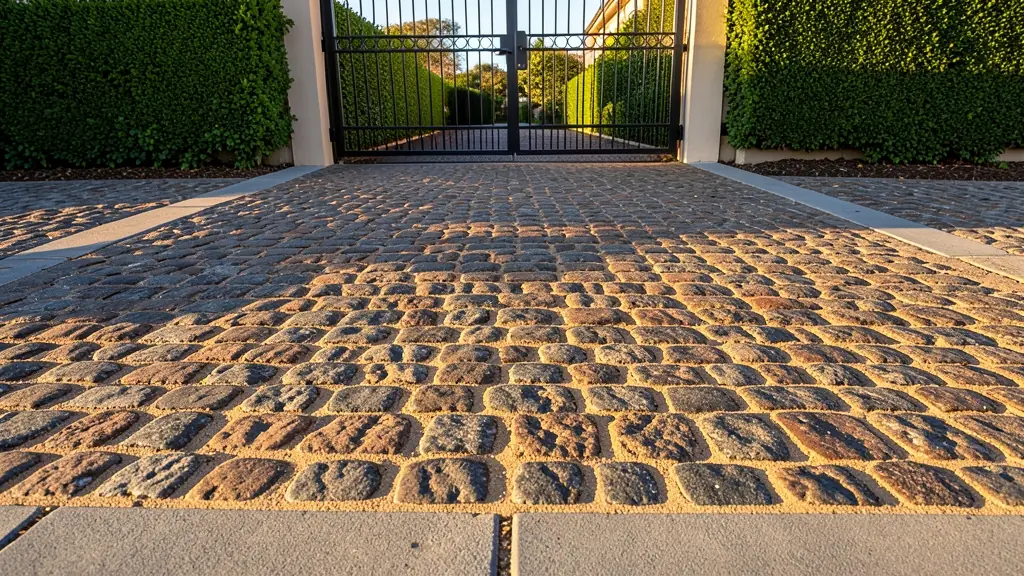
Cobble paving copies the worn streets of old European towns, and in South Africa it mostly arrives as concrete cobbles that were tumbled in a drum after curing so their corners chip and round off. Real stone setts, split from granite or basalt, are rarer and heavier. Both give a driveway entrance or an estate gatehouse a settled, older look. The price of that look is a surface that is never quite flat.
Price guide
A Cape Town paving yard lists cobbles from 100 x 100 to 200 x 200 mm at about R200 per m², supply only, and a Lanseria factory lists 50 mm cobbles at about R260 to R270 per m², excl. VAT. A Cape Town factory lists single cobbles at R4 to R5 each.
A rough guide from published South African prices. The type, thickness, quantity, delivery, the base and VAT all move it.
Tumbled concrete cobbles or real stone setts?
Tumbled cobbles are ordinary pressed concrete units, often made in three or four sizes, rolled until the sharp arrises break away. The colour is pigment in the mix, commonly blended greys, browns and charcoal, and the face is slightly rough. Stone setts are cut blocks of granite or similar rock with split faces. They hold their colour for generations and shrug off tyres, but each one varies in height, and they cost noticeably more to buy and to lay. A Stellenbosch wine farm restoring its old werf might want setts; a new cluster development in Midrand usually goes with concrete.
How are mixed cobble sizes laid?
Most cobble ranges come as a set of sizes packed together on the pallet, and the layer works them in courses or bands rather than a herringbone:
- Random courses: rows of mixed lengths, joints staggered by eye.
- Bands: a strip of cobbles framing a field of plain pavers, cheaper than cobbling the whole drive.
- Fans and arcs: the old street pattern, slow to lay and charged accordingly.
Ask how the sizes are split per pallet before you run the paver calculator, and see paving patterns for how a layout moves the labour bill.
Who struggles on a cobbled surface?
The rounded edges leave a small dip at every joint. Stiletto heels catch in it, pushchair wheels judder, and a wheelchair or walking frame finds a long cobbled path tiring. Wheelie bins rattle on the way to the gate. For a retirement complex, a church entrance or a wedding venue path, lay a smooth strip of flat pavers on the walking line and keep the cobbles for the edges and the car zone.
Where do cobbles suit best?
Entrance aprons where the drive meets the road, borders round a fountain or an old oak, estate gatehouses, the forecourt of a Cape Dutch or Victorian house, and the slow zone in front of a garage. Cars on cobbles need the same thickness and firm base as any driveway paving; the tumbled look does not excuse a soft base.
Who asks for this
- Homeowners
- A cobbled entrance apron or garage forecourt on a Victorian or Cape Dutch house.
- DIY weekenders
- A cobble border round a fountain or tree, laid on a weekend with a rubber mallet.
- Estates and body corporates
- Gatehouse aprons, speed zones and entrance circles that set the tone of the estate.
- Builders and developers
- Cobble bands framing plain paver driveways on new cluster homes for a finished look.
- Landscapers and garden services
- Cobble edging along beds and round water features in an older style garden.
- Shops, offices, schools and churches
- A guest house forecourt or a restaurant courtyard, with a flat strip for wheelchairs.
- Farms, lodges and venues
- A restored werf at a wine farm or a cobbled yard in front of an old cellar.
- Municipal and public works
- Heritage streets and town squares where the council wants an old street surface.
Frequently asked questions
What drives the cobble paving price?
Tumbling is an extra step after curing, so concrete cobbles usually cost more per m² than plain pavers of the same thickness, and stone setts more again. Fan patterns and curves add labour. Ask for supply and laying split out, then compare on the brick paving prices page.
Do cobbles collect more weeds than flat pavers?
A little, yes. The wider, rounded joints hold more sand and catch more seed. Keep them topped up with jointing sand after heavy rain.
Can cobbles go round a pool?
They can, but the uneven face is unpleasant for bare feet and hard to seal evenly. Most pool owners pick a flat, textured paver for the walking area and run a cobble band beyond it.
Who will quote me for cobble paving?
Factories that tumble cobbles, stone yards with setts in stock, and layers who have done cobbled entrances before, all near your address. Each one sends its own price to you. brickpavers.co.za only forwards the request; it holds no stock and lays nothing.